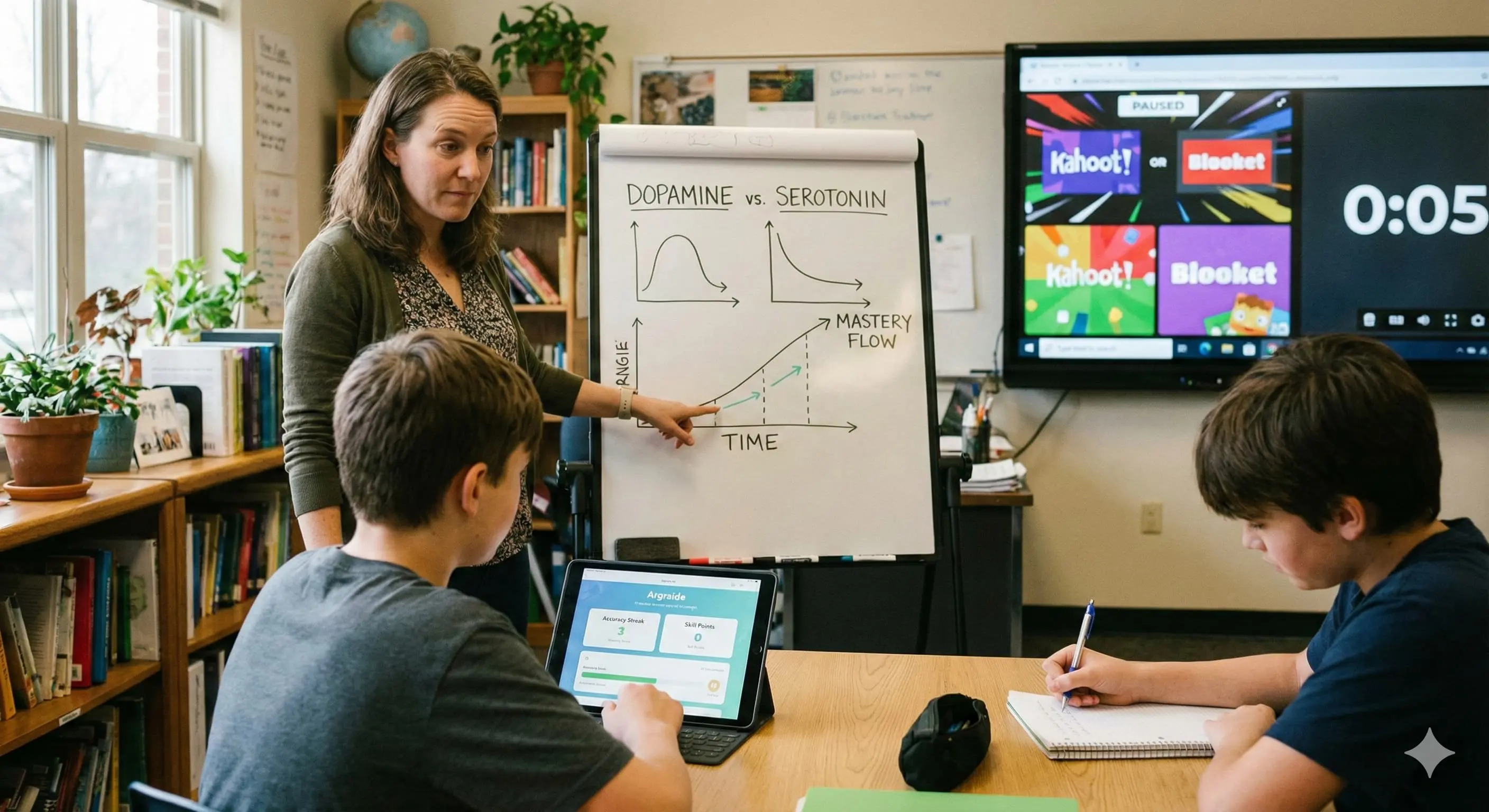

Dopamine vs. Serotonin: Moving Beyond the "Speed Trap" 🧠
Popular platforms like Kahoot! and Blooket have mastered the art of engagement, but they often do so by relying on Variable Ratio Reinforcement—the same psychological mechanic used in slot machines. While this drives energy, it frequently comes at the cost of genuine learning and student mental health.
The Amygdala Hijack
When a timer counts down aggressively or a game allows students to "steal" points from classmates (sabotage mechanics), the brain enters a "fight or flight" mode. This activates the amygdala and can effectively shut down the prefrontal cortex—the area responsible for higher-order thinking, logic, and long-term retention. In these moments, students aren't learning; they are reacting to stress.
The Argraide Difference: Mastery over Speed
At Argraide, we've reimagined the engagement loop to favor Mastery and Flow States.
- Accuracy over Speed: We reward correct answers and streaks, giving students the "think-time" they need to process complex concepts.
- Removing Sabotage: We've eliminated mechanics that encourage pulling others down.
- Skill-Based Rewards: Students earn rewards based on academic progress, fostering intrinsic motivation rather than a chase for lucky dopamine hits.
By creating a "Low Extraneous Load" environment, we ensure that the challenge comes from the content, not the ticking clock. It's time to move from "busy" classrooms to "deep learning" classrooms.