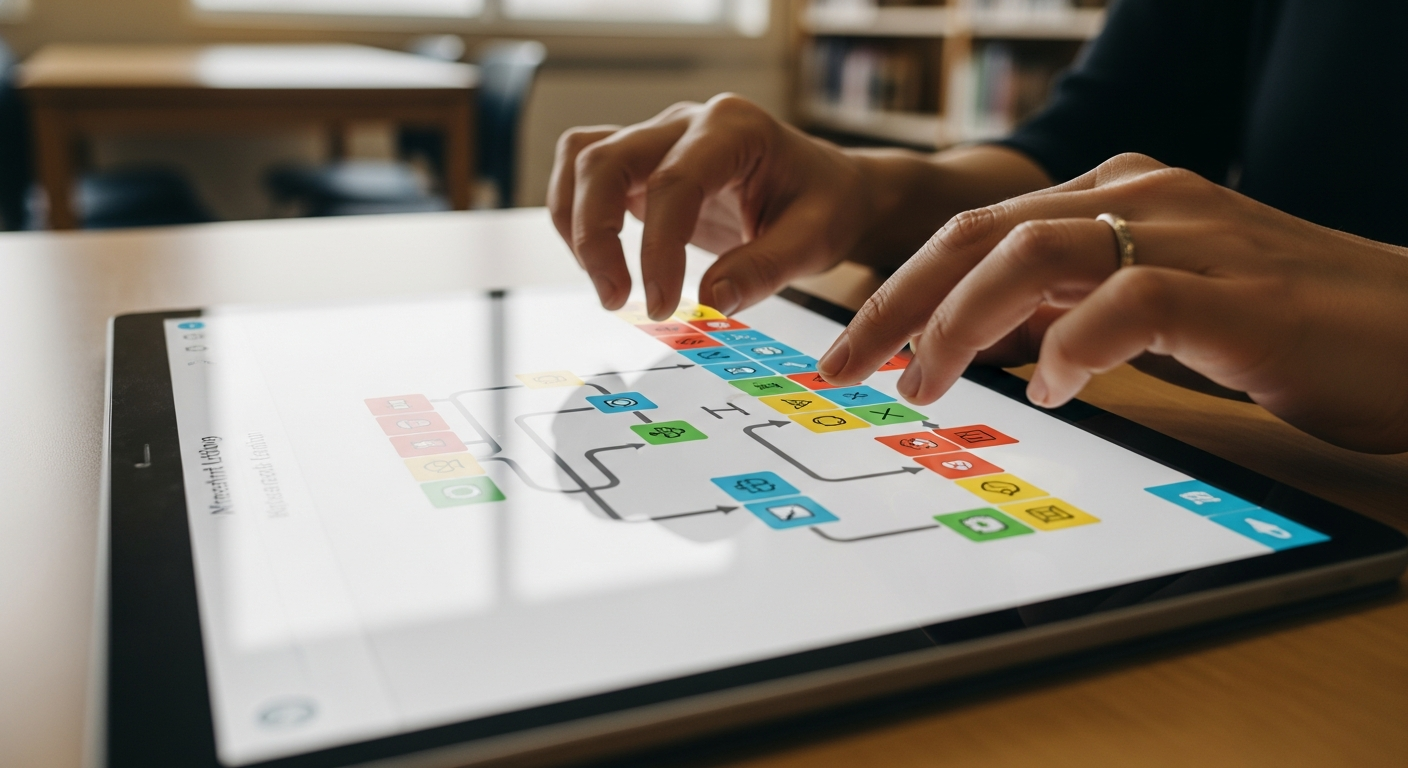

The Shift from Static Resources to Dynamic Learning Experiences
For nearly two decades, the educational marketplace has been dominated by the 'print-and-go' model. Teachers, strapped for time and resources, have relied on platforms like Teachers Pay Teachers (TPT) to source worksheets, lesson plans, and classroom decor. While these platforms solved the immediate problem of content scarcity, they largely solidified a pedagogical approach rooted in rote drill and worksheet-based assessment. As we look at the evolution of the teacher creator economy, it is clear that the future lies not in the digitization of paper, but in the creation of interactive, mastery-based environments.
What is an educational marketplace?
An educational marketplace is a digital platform where educators can buy, sell, or share instructional resources. Historically, these platforms have focused on static files (PDFs, Word documents, and PowerPoints). Modern iterations are beginning to pivot toward interactive software and generative AI tools that allow teachers to build custom simulations and gamified learning experiences.
The Limitations of Legacy Platforms
Platforms like TPT have shown that teachers are the best developers of curriculum. However, the legacy model suffers from three primary issues: a focus on low-level cognitive tasks, the prevalence of speed-based "gamification," and a lack of data privacy. When teachers purchase a generic "math bundle," they are often buying a collection of repetitive drills. These resources frequently mistake speed for mastery, leading to the "race-to-finish" classroom dynamic that undermines deep learning.
Rote Drill vs. Mastery-Based Gamification
While tools like Kahoot or Quizlet have popularized game-based learning, they often lean heavily into dopamine-loop mechanics—timers, leaderboards, and rapid-fire recall—which prioritize anxiety-inducing speed over genuine understanding. True mastery-based gamification, by contrast, uses game mechanics to scaffold complex concepts. Think of a tycoon-style simulation where a student must manage a virtual ecosystem to learn biology. The learning is embedded in the system, not added as a superficial layer of competition.
Rethinking the Creator Economy: A New Pedagogical Standard
Modern teachers are increasingly becoming content designers. They no longer want to just download a worksheet; they want to build an environment that challenges students in the Zone of Proximal Development (ZPD). This requires a shift in how we build and share resources.
The Human-in-the-Loop Advantage
As AI becomes a standard tool in the teacher’s kit, the role of the creator has shifted from "author" to "curator and validator." AI is excellent at generating the mechanics of a simulation or a branching scenario, but it lacks the pedagogical intuition of a classroom teacher. The most effective resources today are those where AI does the heavy lifting of code or structure generation, while the teacher provides the context, the nuance, and the final validation. This "Human-in-the-Loop" approach ensures that content is not just technically sound, but emotionally and culturally relevant to the specific student population.
Privacy as a Pedagogical Pillar
In the current digital landscape, the "TPT alternative" isn't just about better content; it is about better ethics. Many legacy platforms rely on data collection that compromises student anonymity. A modern, forward-thinking approach requires "Zero-Knowledge" privacy, where platforms utilize anonymous identifiers like emoji-based lockers rather than PII (Personally Identifiable Information). When students feel secure, they are more willing to take risks in a simulation or a complex problem-solving task.
How to Transition to Interactive Design: A Step-by-Step Guide
If you are a teacher looking to move beyond static PDFs, follow this roadmap to start designing your own interactive resources:
- Define the Learning Objective (Bloom's Taxonomy): Move away from "memorize these facts" (Remembering) toward "predict the outcome of this scenario" (Applying/Analyzing).
- Identify the Core Simulation: Instead of a quiz, build a scenario. If you are teaching history, don't ask for dates; create a diplomatic negotiation game where decisions have consequences.
- Draft the Logic with AI: Use AI prompts to structure the branching paths of your activity. Ask the AI to create "if-then" scenarios that respond to student choices.
- Validate and Refine: Act as the editor. Play through the activity as a student would. Are the feedback loops constructive? Do they encourage revision and retrieval practice?
- Empower Your Colleagues: Once you have created an effective tool, share it within your professional learning community. When teachers own and refine the content they create, the entire ecosystem improves.
Comparative Analysis: Legacy vs. Modern Approaches
| Feature | Legacy Marketplace Model | Modern AI-Driven Model |
|---|---|---|
| Primary Format | Static PDF / PowerPoint | Interactive Simulations / Games |
| Goal | Efficient delivery of content | Mastery and conceptual depth |
| Teacher Role | Passive consumer | Active designer / Validator |
| Feedback Loop | Speed-based recall | Iterative, feedback-rich cycles |
| Student Privacy | Often tracks PII | Zero-Knowledge (Emoji login) |
Conclusion: The Future is Interactive
Moving away from the legacy educational marketplace is not just about choosing a different platform; it is about embracing a different philosophy. We are entering an era where the divide between "teacher" and "instructional designer" is blurring. By leveraging AI to build simulations that reward genuine understanding rather than speed, and by insisting on privacy-first infrastructure, we can move the needle from rote drill to authentic mastery.
The future of teacher-created content is not about how many worksheets you can sell; it is about how many students you can engage in rigorous, thoughtful, and safe exploration. The tools are ready. It is time for educators to reclaim the role of architect in the classroom.