
At 10:17 on a Wednesday, Leila Ortiz, a fictional seventh-grade science teacher, hears a student say, “We’re out of moves. Can we reset?”
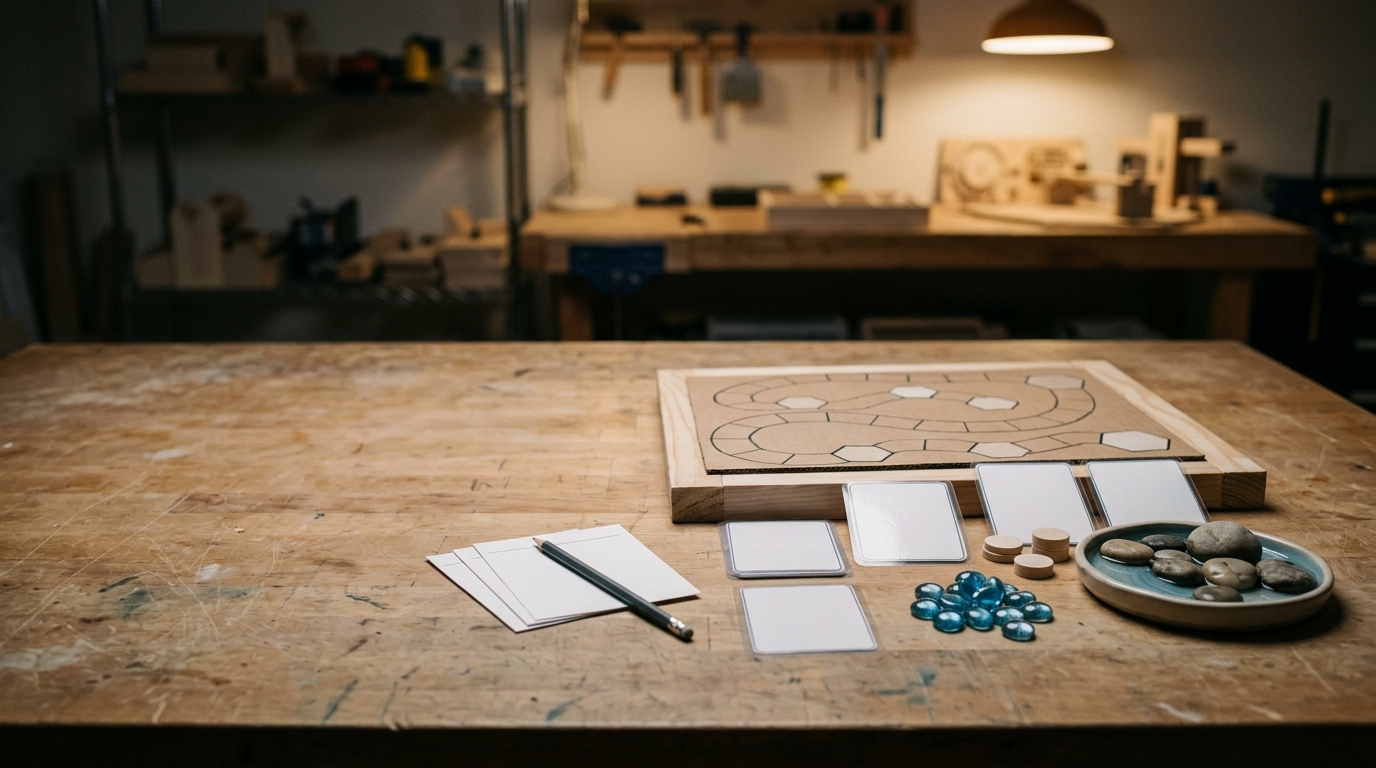
The class is playing Creek Rescue, a tabletop game Leila built for a unit on watersheds. Each team has a laminated map, event cards, wooden counters, and a short set of data about algae, insects, fish, and dissolved oxygen. Teams choose an intervention, predict what will happen to the stream, and earn points when their prediction is accurate.
Leila wants students to reason through cause and effect. The scoring system, however, gives a bonus to the first team to finish a round. A wrong answer costs a turn. The answer card then reveals the correct choice in bold red print.
Within minutes, one team is guessing quickly and collecting counters. Another team is taking longer, discussing the evidence, and losing turns. When Leila asks the high-scoring team to explain why fertilizer runoff can lead to fish loss, the students can repeat a phrase from the card. They cannot explain the chain of events.
By lunch, Leila has identified the problem. Her game allows another attempt, but it does not help students understand what changed between attempts. “Try again” has become permission to guess again. That distinction sits at the heart of growth mindset in game design: struggle only supports learning when the game gives students a useful way through it.
Productive struggle has a boundary
More difficulty does not automatically create more learning.
A growth mindset, in Carol Dweck’s framework, is the belief that ability can develop through effective strategies, instruction, feedback, and practice. It is not the belief that effort alone guarantees improvement. Telling a student to keep trying at an inaccessible task may produce persistence, but it does not provide a better strategy.
The research also calls for modest claims. A 2019 Nature study by David Yeager and colleagues included more than 12,000 ninth-grade students in 65 U.S. schools. Its growth-mindset intervention produced small overall effects, with stronger results for lower-achieving students in schools that supported challenge and belonging. A short message about the brain did not carry the intervention by itself. The surrounding instruction mattered.
Productive struggle has a similar boundary. Manu Kapur’s work on productive failure examines what happens when learners attempt a meaningful problem before receiving direct instruction. The approach can support conceptual understanding and transfer when students have enough prior knowledge to make a serious attempt and receive explanation afterward. The failure is followed by consolidation; it is not left hanging.
That last condition matters in a game. A novice may be juggling unfamiliar rules, a new vocabulary set, a map, a timer, and a social negotiation all at once. If the rules consume working memory, the resulting difficulty may have little to do with the learning target. Leila’s first version of Creek Rescue made students manage the game before they had a clear way to reason about the science.
Productive struggle does not mean leaving students alone until they find the answer. It means asking for meaningful thinking before the answer is supplied, then giving enough information for a better second attempt.
Design the moment after the miss
Start with the error path, not the winning screen. In mastery-based game design, the most important mechanic may be what happens immediately after a wrong move.
Leila kept the watershed map but redesigned one round around a single target: explain how excess nutrients can reduce oxygen available to aquatic life. The revised sequence has four parts.
First, students make a prediction and give one reason before drawing a consequence card. This creates an initial claim that can later be examined. Next, the consequence card gives evidence rather than a verdict: algae increased, decomposition increased, and oxygen levels fell. It does not announce which sentence was correct.
Students then complete a four-line revision slip:
My first claim was:
Evidence I missed was:
My revised claim is:
I changed my thinking because:
Finally, they face a new case. The surface changes—a warmer stream, a different source of organic matter, or a different set of observations—but the causal idea remains. Students must apply the relationship rather than memorize which card earns points.
This loop turns an error into an object students can inspect. It also gives Leila something more useful than a score. She can see whether students misunderstood the role of algae, ignored the data, or confused correlation with cause.
Feedback should point toward a strategy or a relationship, not simply expose the answer. A hint might direct students to compare two variables, represent the chain with arrows, or identify which observation their claim fails to explain. If every hint costs points, students may avoid the support that would help them learn. If every retry is consequence-free guessing, students may stop reading the evidence. For a short activity, two meaningful attempts are often enough: the second attempt must use new information and include an explanation.
Leila also removes the penalty for revising. The trade-off is real. Her class completes fewer rounds, but each round leaves behind evidence of thinking. That is a better use of twenty minutes than racing through five shallow questions.
Make mastery survive the game
Mastery has to survive outside the game’s rules.
Players learn patterns quickly. A student may discover that choosing the card with the largest number usually wins, or that a particular icon signals the safest move. Two correct turns can show familiarity with the interface rather than understanding of the subject. This is the counterintuitive risk of polished educational games: the more consistent the reward pattern, the easier it can be to play the system.
Benjamin Bloom’s 1968 model of mastery learning included corrective instruction and a second chance. The second chance was not a duplicate performance after a quick reset. It followed diagnosis and correction. A useful game loop follows the same logic.
Leila therefore adds an exit task that contains no map, counters, or familiar card language. Students receive a short description of a different stream problem and write a claim, cite two pieces of evidence, and explain the causal link. Her rubric gives separate credit for the claim, evidence, and reasoning. Time and turn order do not enter the score.
This produces three kinds of evidence: what students did during play, how they explained a revision, and whether they could transfer the idea to a new situation. No single piece is perfect. Together, they are stronger than a leaderboard or a final correct answer.
The result is less dramatic than a sudden jump in points. Some students who lost the first round now produce the clearest explanations because the revision slip made their thinking visible. Others still need direct teaching about decomposition and oxygen. That information tells Leila what to teach next. The game has become a diagnostic activity rather than a disguise for a quiz.
Prototype one loop before Friday
Do not rebuild an entire unit. Choose one existing activity and alter one failure-to-revision sequence.
Write the learning target as a verb: explain, classify, compare, calculate, or justify. List two mistakes a novice is likely to make. For each mistake, prepare one piece of evidence or one hint that points students toward the relationship they need to inspect. Add a short revision prompt, then create one transfer task with different surface details. Whether the scenario was drafted by you, a colleague, or a generative tool, check every fact, clue, and answer key before students see it. A flawed prompt creates confusion that can look like productive struggle.
This approach fails when students lack the prerequisite knowledge to make a serious attempt, when the rules are harder than the content, when failure is public and humiliating, or when no follow-up instruction occurs. Give a brief worked example or vocabulary preview when access is the problem. Offer oral, diagram-based, or written explanations when students need different ways to show reasoning. If speed is genuinely the target—after accuracy and strategy are established—timed practice may have a place. Speed should not stand in for conceptual mastery.
Leila keeps the map, the event cards, and the parts she made herself. She changes the scoring, adds the revision slip, and reserves the final minutes for the transfer task. Before your next game-based lesson, print one four-line revision slip, remove one speed bonus, and write one new-context prompt. Read the slips before planning the next round; they will show whether students are merely recovering from a miss or actually learning from it.