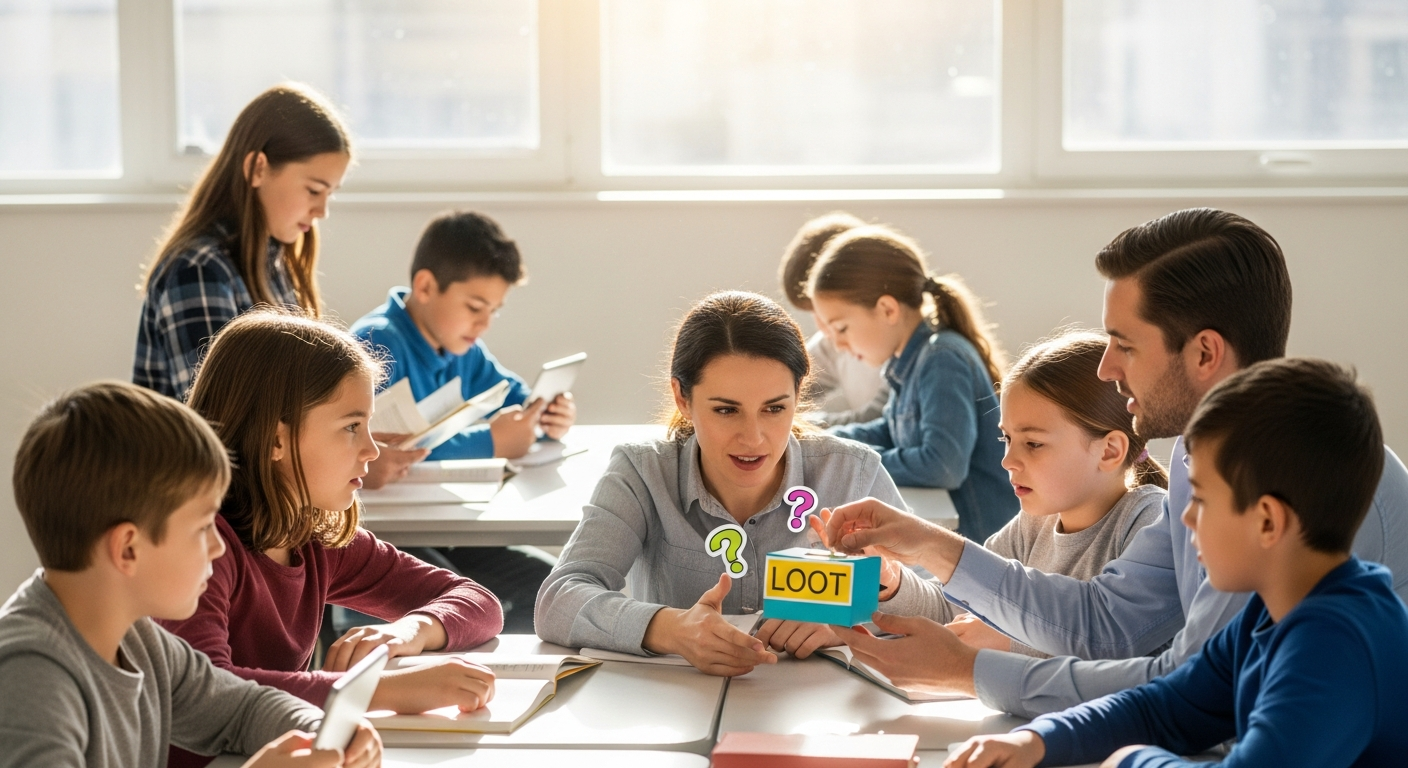

The Problem with Random Rewards in the Classroom
Many educators are familiar with the rush of excitement that fills a classroom when a high-energy game is introduced. Whether it is the rapid-fire competition of Kahoot or the flashcard-based races of Quizlet, these tools have become staples in the modern teacher's toolkit. However, a concerning trend has emerged: the creeping integration of variable reward schedules—essentially, loot boxes in education. While these mechanics are designed to boost engagement, they often prioritize superficial participation over the deep, cognitive engagement required for true mastery.
What are loot boxes in education?
Loot boxes in education are digital mechanics where students receive randomized rewards, virtual items, or power-ups based on chance rather than demonstrated skill. Much like in commercial video games, the goal is to trigger a dopamine release by creating uncertainty about what the reward will be. While this may temporarily increase time-on-task, it fundamentally shifts the student's focus from the learning objective to the gambling-like mechanic.
The Psychology of Engagement vs. The Mechanics of Addiction
To understand why random rewards classroom strategies often fail, we must distinguish between motivation and manipulation. Behavioral psychology tells us that variable ratio schedules of reinforcement—the same mechanism used in slot machines—are incredibly effective at keeping subjects performing a task. In a classroom, if a student earns a random chance at a 'legendary' digital badge for completing a worksheet, they might work faster. But are they learning more?
Why random rewards hinder long-term retention
- Extrinsic vs. Intrinsic Motivation: When rewards are randomized, students begin to value the 'loot' rather than the content. Once the rewards stop, the motivation to learn often vanishes.
- Anxiety and Frustration: Unlike mastery-based gamification, which provides clear pathways to success, random rewards create a 'near-miss' effect that can lead to frustration and decreased self-efficacy.
- The Illusion of Progress: Students may feel they are 'leveling up' because of their collection of virtual items, even if they have not met the learning standards defined by Bloom’s Taxonomy.
Comparing Approaches: Random vs. Mastery-Based Gamification
| Feature | Random Rewards (Loot Box Style) | Mastery-Based Gamification |
|---|---|---|
| Primary Driver | Dopamine (Chance) | Competence (Understanding) |
| Feedback | Intermittent & Unpredictable | Immediate & Constructive |
| Goal | Speed and Engagement | Skill Acquisition and Depth |
| Student Mindset | 'What do I get?' | 'What can I do?' |
Ethical Gamification: Moving Beyond the Slot Machine
Gamification is not inherently bad. When done right, it is one of the most powerful tools in modern education. The issue lies in the design of the reward system. Ethical gamification relies on the Zone of Proximal Development (ZPD) to ensure that challenges are neither too easy nor too difficult, providing a sense of accomplishment that is tied directly to the student’s effort and growth.
Designing for Mastery
Instead of relying on luck, transform your classroom into a space where students own their learning.
- Define Clear Objectives: Every activity should map to a specific learning standard.
- Provide Agency: Allow students to choose their path. Instead of forcing them to grind through rote drills, offer simulations or tycoon-style games where they must apply knowledge to solve complex problems.
- Human-in-the-Loop Validation: AI can assist in generating creative scenarios, but the teacher must always review and curate these experiences to ensure they are age-appropriate and educationally sound.
Actionable Insights for Teachers
If you find yourself using platforms that rely heavily on random rewards, consider these shifts:
- Pivot to Retrieval Practice: Replace high-speed guessing games with structured retrieval practice that rewards students for explaining 'why' and 'how,' not just picking the correct multiple-choice option.
- Prioritize Privacy: Ensure that the tools you use respect student data. Opt for systems that use secure, zero-knowledge identifiers, such as emoji-based lockers, rather than requiring PII to track progress.
- Empower Student Creators: Allow students to create their own challenges or simulations. When students act as designers, they are forced to synthesize the information, which is a much higher-order cognitive task than simply consuming gamified content.
The Future of Interactive Learning
We must stop treating students like consumers of digital engagement and start treating them as architects of their own knowledge. The industry trend is moving away from 'gamified drills' toward immersive, inquiry-based simulations that challenge students to think critically.
Why Mastery-Based Gamification Wins
Unlike systems that rely on superficial competition, mastery-based systems reward the persistence required to solve a problem. In a tycoon-style game, a student might lose their virtual business if they fail to apply economic principles correctly. This is not 'punishment' or a bad 'pull' from a loot box; it is authentic feedback that forces them to re-evaluate their strategy and try again. This is where real learning happens.
Conclusion: Moving Toward Ethical Design
As we look at the evolution of EdTech, the focus must remain on the human element. AI should not be used to automate rote tasks or create psychological traps. Instead, it should be used to empower teachers to create high-quality, interactive content that they truly own and control. By moving away from the distraction of random rewards and toward the substance of mastery-based design, we can build a classroom culture that values deep understanding over dopamine hits.
Let’s challenge the status quo. If a tool doesn’t contribute to a student's ability to demonstrate understanding, it’s time to rethink its place in your curriculum. Focus on activities that build skills, protect student privacy, and put the teacher back in the driver's seat of the educational journey.