The Differentiated Instruction Dilemma: Beyond the One-Size-Fits-All Classroom
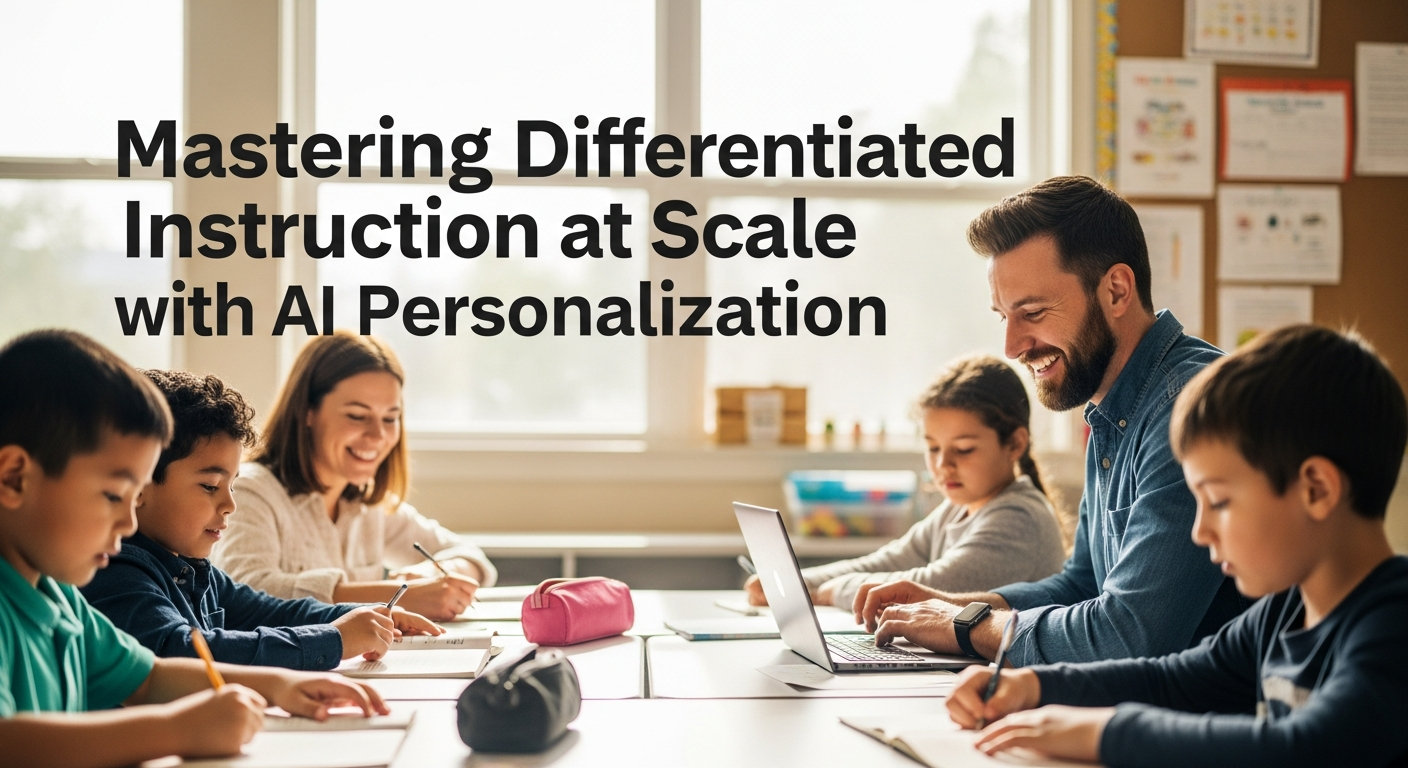
Every educator knows the feeling: you spend hours crafting a lesson plan, only to realize that for ten students, the material is far too easy, while for another ten, it is completely inaccessible. This is the central friction of modern teaching. Traditional methods of differentiated instruction—creating multiple versions of handouts, managing varying reading levels, and tracking individual progress—often collapse under the sheer logistical weight of managing 30 students at once.
What is Differentiated Instruction?
Differentiated instruction is a framework that involves providing students with different avenues to acquiring content, processing ideas, and developing products. It is not about creating thirty different lesson plans; it is about adjusting the complexity, support, and engagement level of a single core objective to meet students where they are in their learning journey.
For decades, teachers have relied on tools like Teachers Pay Teachers (TPT) to source pre-made materials. While these resources are helpful, they are often static. If a resource doesn't fit a specific student's need, the teacher is back to square one. Similarly, while tools like Kahoot or Quizlet have popularized gamification, they frequently fall into the trap of rewarding speed and memorization—what we might call 'dopamine-loop' learning—rather than deep, conceptual understanding.
Leveraging AI for True Personalized Learning
AI differentiation represents a paradigm shift. Instead of a teacher struggling to manually customize a worksheet, they can now act as an architect, using AI to generate high-quality, scaffolded experiences that adapt to student needs. The goal of AI-driven personalized learning is to maintain the Zone of Proximal Development (ZPD)—that sweet spot where a task is challenging but achievable with the right support.
Comparing Approaches to Differentiation
| Feature | Traditional Methods | Legacy EdTech (e.g., Kahoot/Quizlet) | Modern AI-Driven Approach |
|---|---|---|---|
| Core Goal | Standardization | Engagement via Competition | Mastery-Based Understanding |
| Feedback Type | Delayed (Grading) | Instant (Points/Speed) | Qualitative (Instructional) |
| Personalization | Low (Grouping) | Low (Randomized Order) | High (Scaffolded Complexity) |
| Learning Outcome | Memorization | Fluency/Recall | Deep Conceptual Synthesis |
When we use AI to create simulations or tycoon-style games, we move away from 'drilling' and toward 'demonstrating.' For instance, instead of asking a student to memorize historical dates, an AI-generated activity might place them in a leadership simulation where they must manage resources based on their understanding of historical economic policies. This embeds the learning in context, making the assessment of understanding authentic rather than performative.
The Human-in-the-Loop Philosophy
One of the most persistent myths about AI in education is that it aims to replace the teacher. In reality, the most effective pedagogical implementations are 'human-in-the-loop.' AI provides the speed and the draft, but the teacher provides the pedagogical soul.
Why Teachers Must Validate AI Content
- Contextual Nuance: Only a teacher knows the emotional tone and specific cultural background of their classroom.
- Curriculum Alignment: AI can suggest activities, but the teacher ensures they align with the specific learning standards of the district.
- Pedagogical Ownership: When teachers validate and refine AI-generated content, they retain ownership. This creates a library of resources that is uniquely tailored to their teaching style, rather than relying on generic, off-the-shelf content.
By keeping the teacher at the center of the design process, we ensure that the technology remains a tool for empowerment rather than a black box that dictates the classroom experience.
Mastery-Based Gamification: Beyond Dopamine Loops
Gamification is often misunderstood as simply adding a leaderboard to a quiz. When we talk about mastery-based gamification, we refer to systems where progression is tied to competence, not reaction time. In a tycoon-style game or an interactive simulation, the 'win state' is not reached by being the fastest, but by demonstrating a mastery of the underlying concepts.
Actionable Insights for AI-Integrated Lessons
- Use AI to Generate Scaffolding: Prompt an AI tool to rewrite a complex text into three different reading levels to support diverse learners.
- Transition from Memorization to Simulation: Replace a quiz with an AI-generated scenario where students must solve a problem using the facts they have learned.
- Prioritize Data Privacy: Ensure that the platforms you use follow 'Zero-Knowledge' principles. Tools that avoid collecting PII (Personally Identifiable Information) and use secure, anonymous methods like emoji-lockers for logins are essential for maintaining student trust.
Addressing the 'Anxiety Gap'
Legacy gamified tools often inadvertently create 'speed-based anxiety.' Students who do not process information instantly feel left behind. By using AI to create self-paced, mastery-based activities, we shift the focus to the quality of the output. If a student needs to run a simulation three times to understand the variables, that is a feature, not a bug. It is a genuine iterative learning process that mirrors professional work environments.
Building the Future Classroom
As we look forward, the role of the teacher is evolving from an 'information deliverer' to a 'learning architect.' AI is the ultimate assistant for this transition. It handles the heavy lifting of content generation, allowing teachers to focus on the human connections that facilitate true student growth.
To effectively scale differentiated instruction, we must embrace tools that value student agency and teacher creativity. The future of EdTech is not in closed, proprietary systems that reward rote speed, but in open, generative systems that allow teachers to build authentic, mastery-oriented experiences that meet every student where they are.
By leveraging AI to differentiate at scale, we can finally stop teaching to the middle and start designing for the individual. The technology is here, the pedagogical frameworks are established, and the capacity for teachers to create meaningful, personalized learning experiences has never been greater. It is time to move past the limitations of the past and step into a more nuanced, effective, and human-centric way of teaching.