Moving Beyond the Point-Race: Redefining Student Engagement
For decades, the classroom experience has been defined by a race. Whether it is a race to finish a worksheet, a race to be the first to raise a hand, or a race to climb the leaderboard in digital tools like Kahoot or Quizlet, the message sent to students is clear: speed equals intelligence. While platforms like Kahoot are excellent for quick formative check-ins, they often inadvertently trigger performance anxiety. When the primary motivator is a flickering timer, students prioritize rapid retrieval over deep comprehension.
What is Mastery Learning?
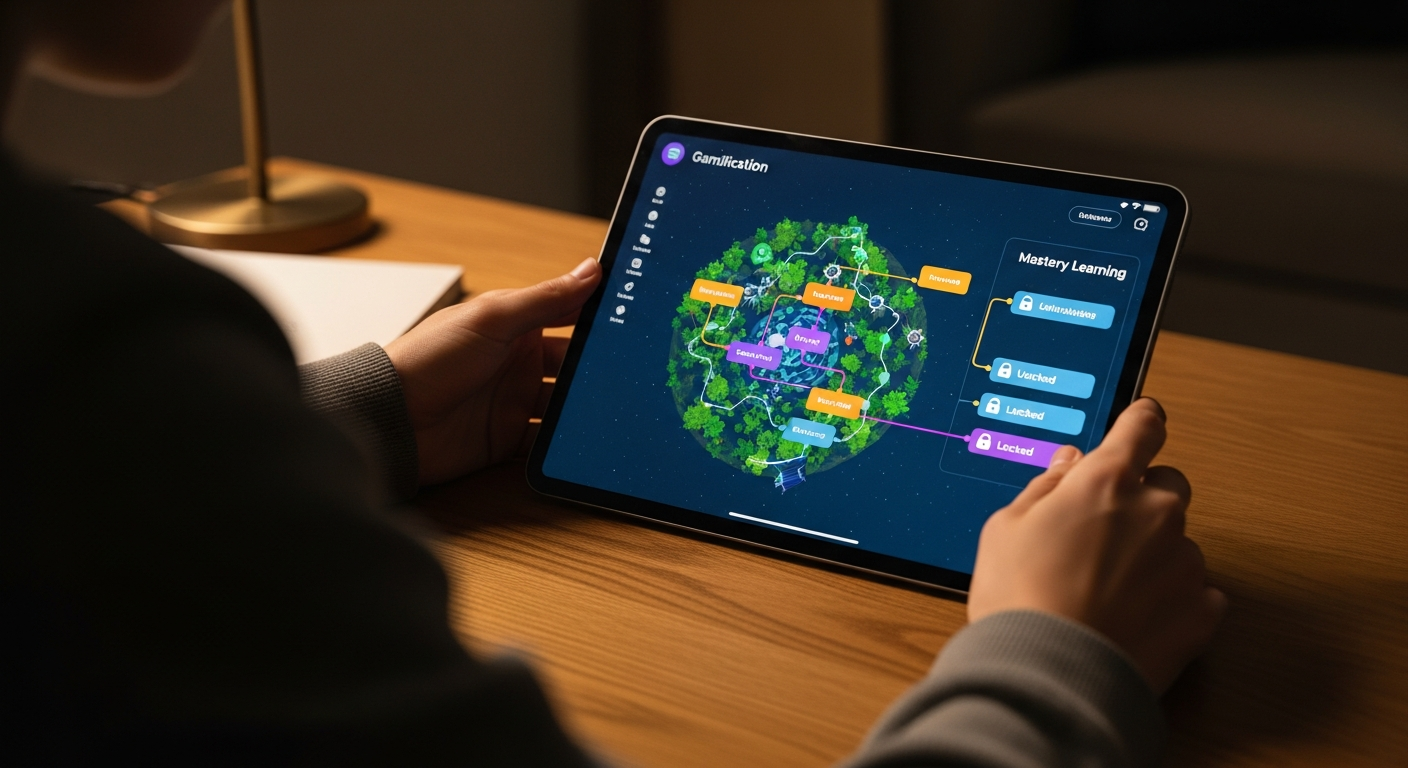
Mastery learning is an instructional strategy where students must demonstrate a thorough understanding of a concept before moving on to the next level of complexity. Unlike traditional models that move the entire class forward on a fixed schedule regardless of individual comprehension, mastery learning ensures that foundational gaps are filled, creating a stable platform for future academic growth.
When we integrate mastery-based progression into gamified systems, we stop incentivizing the "fast-but-shallow" learner. Instead, we reward the student who persists, iterates, and eventually understands. This shift is essential for building student confidence, as it replaces the fear of failure with the reality of "not yet."
The Psychology of Progression: Why Mastery Beats Leaderboards
Traditional gamification often relies on extrinsic rewards: badges, streaks, and points. While these offer a temporary dopamine hit, they rarely sustain long-term engagement. In fact, research suggests that when external rewards are removed, interest in the underlying task often declines. This is the 'overjustification effect.'
Gamification vs. Meaningful Simulation
To move toward authentic learning, educators should distinguish between two types of game design:
- Surface Gamification: This includes mechanics like leaderboards, streaks, and timed quizzes (e.g., typical settings in Quizlet). These focus on social comparison and speed.
- Mastery-Based Simulation: This involves complex, tiered activities—such as tycoon-style games or branching simulations—where success is dependent on applying knowledge to solve problems (e.g., Articulate or custom-built scenarios).
By adopting a mastery-based approach, we align with the Zone of Proximal Development (ZPD). When a student is challenged at the edge of their current ability but provided with the tools to master the task through repeated, scaffolded attempts, anxiety decreases and self-efficacy skyrockets.
How-To: Implementing Mastery-Based Progression
Creating a mastery-based environment does not require you to be a software developer. It requires a shift in how you design the flow of your activities. Here is a step-by-step framework for transitioning your classroom activities:
- Deconstruct the Objective: Break a broad learning standard into "micro-competencies." If the goal is "Understanding Ecosystems," your micro-competencies might be "Identifying Producers," "Mapping Energy Flow," and "Analyzing Human Impact."
- Set the Mastery Gate: Define what success looks like for each competency. This is not a letter grade; it is a demonstration of skill. It could be a successful simulation outcome or a correct explanation of a system.
- Create Iterative Feedback Loops: Provide students with content that allows for revision. If they fail to master a step, they shouldn't just get a 'C'; they should get a new challenge or a different perspective on the same concept.
- Human-in-the-Loop Validation: Use your expertise to review student outcomes. AI can assist in generating the scaffolding and the simulations, but the teacher remains the final arbiter of what constitutes 'mastery.'
Comparative Analysis: Traditional vs. Mastery Systems
| Feature | Traditional Gamification | Mastery-Based Progression |
|---|---|---|
| Core Metric | Speed and Accuracy | Depth of Understanding |
| Feedback Type | Correct/Incorrect (Binary) | Explanatory and Iterative |
| Student Goal | Beat the Timer/Peers | Achieve Competency |
| Emotional Outcome | Competitive Anxiety | Intellectual Confidence |
Protecting the Learner: Privacy and Ownership
As we integrate more digital tools into the classroom, the conversation around data privacy is non-negotiable. Many platforms, including those popularized by TPT or large-scale LMS providers, often collect significant amounts of PII (Personally Identifiable Information). Modern educators must prioritize "Zero-Knowledge" privacy solutions.
When a student logs in with an emoji-based locker rather than a traditional email address or school ID, the focus remains entirely on the work. This creates a safe psychological space where students feel free to experiment and fail—a prerequisite for mastery. Furthermore, we must advocate for models where teachers own the content they create. When teachers use AI to synthesize high-quality simulations and games, they should retain the intellectual property of those resources, empowering them as creators rather than just consumers of third-party content.
Building Confidence Through Retrieval Practice
Mastery is not just about the first encounter with a concept; it is about the ability to recall and apply it later. Incorporating Retrieval Practice—the act of recalling information without prompts—into your gamified progression ensures that learning sticks.
Instead of "drill and kill" flashcards, imagine a simulation where a student must manage a city's energy grid. To keep the city running, they must recall the impact of different energy sources they learned about earlier in the week. This is mastery in action. It is contextual, it is challenging, and it is vastly more rewarding than memorizing a definition for a test.
Conclusion: The Path Forward
Confidence is not the absence of struggle; it is the presence of resilience. When students understand that they are in control of their own progression—that they have the time, the tools, and the path to master a concept—they stop fearing failure. They begin to see it as a data point in their learning journey.
As we look toward the future of education, the goal is clear: we must leverage the power of AI to unburden teachers from the administrative tedium of content creation, allowing them to focus on the human elements of teaching: mentorship, validation, and fostering a deep, genuine love for inquiry. By moving away from speed-based anxiety and toward mastery-based systems, we are not just teaching subjects; we are teaching students how to learn, how to persist, and how to believe in their own intellectual capacity.