
The Confidence Crisis in Modern Classrooms
Many educators observe a recurring pattern: students who are bright and capable often freeze when faced with high-stakes assessments. This anxiety is frequently rooted in the traditional 'one-shot' approach to testing. When a student's entire grade hinges on a single performance event, the focus shifts from genuine mastery learning to the survival strategy of rote memorization. This creates a fragile form of academic confidence that evaporates the moment the context of a question changes.
To bridge this gap, educators are turning toward structured progression systems. By shifting the focus from speed-based recall—often encouraged by tools like Kahoot or Quizlet—to deep, iterative mastery, teachers can create environments where students feel safe to fail, iterate, and eventually succeed.
What is Mastery-Based Progression?
Mastery-based progression is an educational framework where students advance through content only after demonstrating a clear, predefined level of understanding. Unlike traditional models that move the entire class forward on a fixed timeline, mastery learning allows for flexible pacing, ensuring that foundational concepts are solidified before moving to more complex cognitive tasks. This aligns perfectly with Vygotsky’s Zone of Proximal Development, as it keeps students in the 'sweet spot' where the work is challenging but achievable.
The Role of Gamification in Mastery
When we discuss gamification, it is essential to distinguish between extrinsic 'dopamine loops' and intrinsic 'progression mechanics.' Many legacy platforms focus on speed-based leaderboards, which can inadvertently punish slower learners and reward those who have simply memorized the most facts.
In contrast, a thoughtfully designed progression system uses game mechanics—like leveling up, unlocking new simulation scenarios, or earning experience points for complex problem-solving—to provide a clear roadmap of progress. This approach replaces the anxiety of the 'final exam' with a series of manageable, iterative goals. The goal is not to see who finishes first, but to ensure that every student can successfully navigate the final level of a simulation or solve a complex tycoon-style management puzzle.
Comparing Learning Methodologies
To understand why progression-based models are gaining traction, it is helpful to contrast them with traditional, drill-heavy approaches.
| Feature | Traditional Drill/Speed Model | Mastery-Based Progression |
|---|---|---|
| Primary Metric | Speed of recall | Depth of understanding |
| Failure Handling | Penalty-heavy (loss of points) | Iterative (safe to retry) |
| Feedback Loop | Immediate but surface-level | Diagnostic and actionable |
| Student Mindset | Anxiety/Performance-driven | Growth/Competency-driven |
Why Drill-Based Tools Often Fall Short
Platforms like Kahoot or Quizlet are staples in many classrooms, yet they often prioritize rapid-fire recall. While this can be useful for vocabulary, it rarely develops the critical thinking skills required for real-world application. When learning is gamified solely through speed, students learn to 'game the system'—guessing quickly rather than thinking deeply. This can erode long-term confidence because the student knows, at some level, that their 'success' is based on pattern recognition rather than true mastery.
Designing Effective Progression Systems: A How-To Guide
Transitioning to a mastery-based approach doesn't require a total overhaul of your curriculum. It requires a shift in how you structure your learning outcomes.
- Identify Core Competencies: Break down your unit into 'levels' or 'phases' of understanding. What is the fundamental skill required for the first phase?
- Create Low-Stakes Entry Points: Allow students to attempt a challenge multiple times without fear of a permanent 'F.' Use AI-assisted generators to create variations of the same simulation so students can practice without repeating the exact same problem.
- Integrate 'Human-in-the-Loop' Validation: While AI can help you structure these simulations or tycoon-style games, the teacher must remain the final arbiter of quality. Ensure that the logic of the game aligns with your learning objectives.
- Prioritize Process Over Output: Reward students for the strategies they use to solve a problem in a simulation, rather than just the final answer.
Using Tycoon Games and Simulations to Build Agency
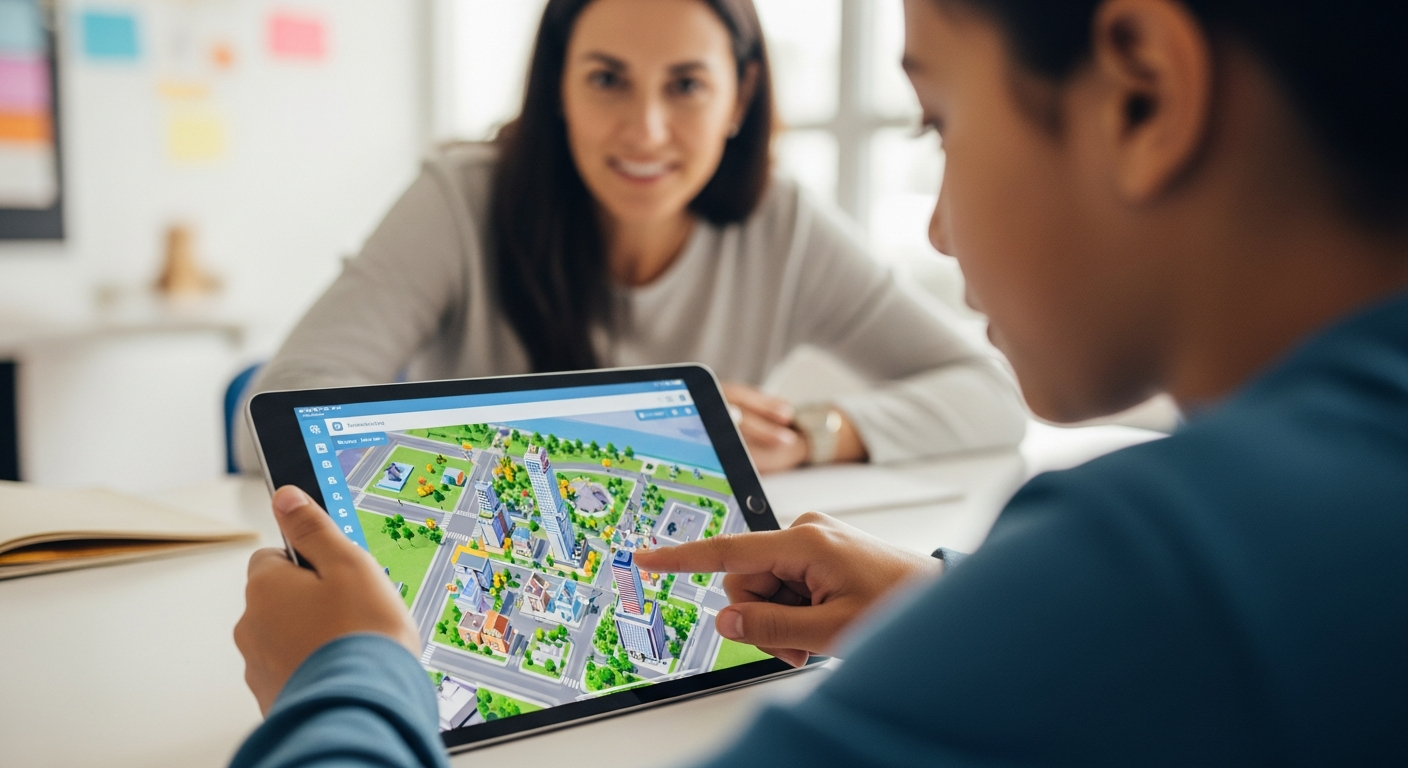
Tycoon games are an excellent vehicle for mastery-based learning. In a well-designed simulation, a student might manage a virtual city or a historical enterprise. To progress to the next stage, they must balance resources and react to variables. This mimics real-world application of knowledge. When a student 'fails' in a game, they don't receive a failing grade; they receive a prompt to analyze their resource management and try again. This builds resilience—a core component of student confidence.
Privacy and the Ethical Use of AI
As we integrate more technology into the classroom, the question of student data privacy becomes paramount. Many commercial platforms collect PII (Personally Identifiable Information) to track user behavior. A more modern, ethical approach utilizes 'Zero-Knowledge' systems. For example, students can interact with learning platforms via anonymous, emoji-based lockers. This ensures that the focus remains entirely on the work produced and the mastery achieved, rather than the commodification of student data.
Empowering the Teacher Creator
One of the most exciting shifts in EdTech is the movement toward teacher-owned content. Rather than relying on static, publisher-provided materials, teachers can use AI to synthesize their own unique expertise into interactive simulations. When teachers create their own activities, they feel more invested in the curriculum, and that passion is transferred to the students.
Conclusion: The Path Forward
Building student confidence is not about making school 'easier.' It is about making the path to mastery more transparent, iterative, and responsive to individual needs. By moving away from speed-based anxiety and toward progression systems that reward demonstrated understanding, we provide students with the psychological safety they need to take intellectual risks.
As you integrate these concepts into your practice, remember that the most effective tool in the classroom remains the relationship between teacher and student. Technology is simply the scaffolding. By utilizing tools that prioritize privacy, allow for human oversight, and promote genuine mastery, you can transform your classroom into a space where every student has the opportunity to succeed at their own pace.