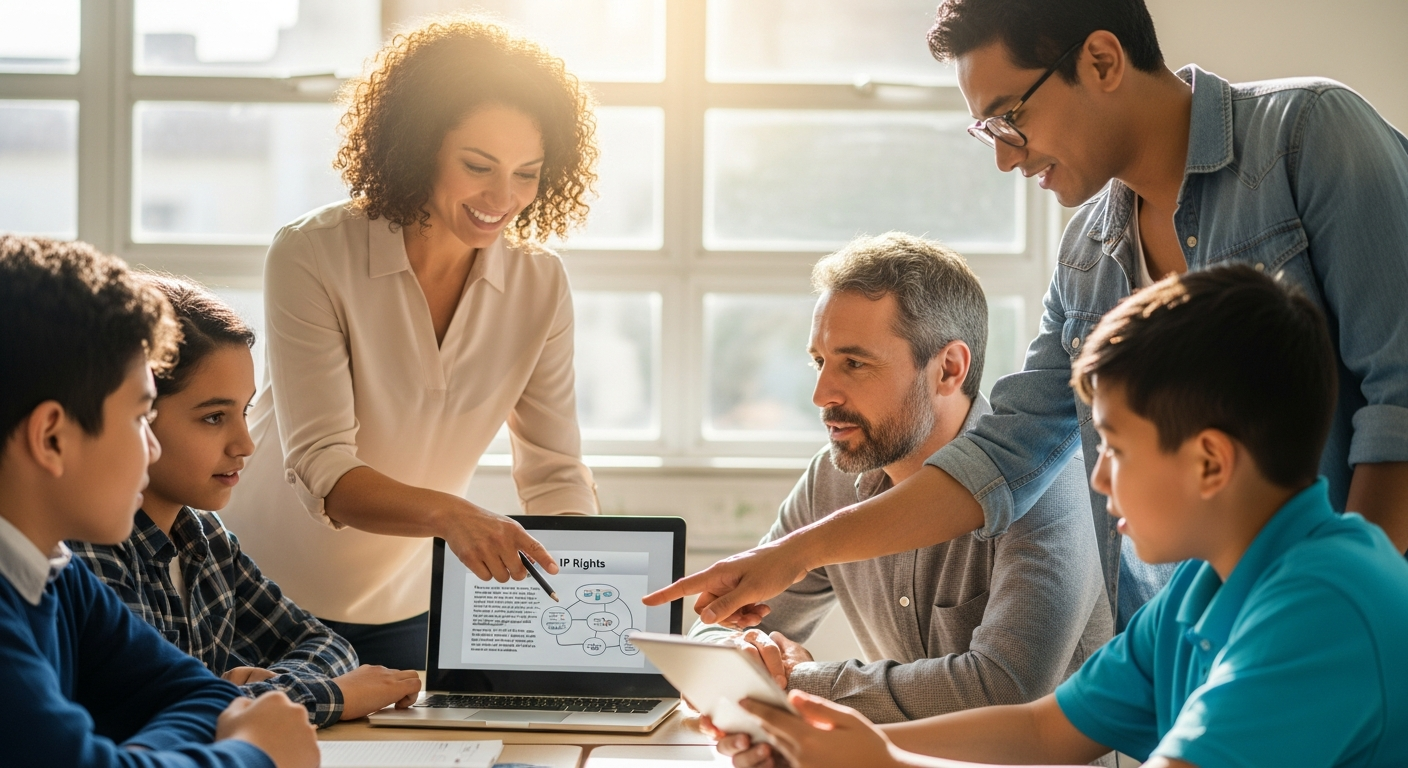

The Silent Crisis in the Classroom: Defining Educational Content Ownership
For decades, teachers have been the primary architects of the classroom experience. From hand-drawn worksheets to complex simulations, educators have poured countless hours into materials that bring lessons to life. However, the rise of AI-assisted creation has turned the spotlight onto a long-simmering issue: teacher IP rights. When a teacher uses artificial intelligence to generate a complex tycoon game or a mastery-based assessment, who legally owns that content? As districts and platforms grapple with these questions, educators find themselves at a crossroads between innovation and intellectual property vulnerability.
What are teacher IP rights?
Teacher IP rights refer to the legal claim an educator has over the original instructional materials they produce. In most school districts, the 'work-for-hire' doctrine often complicates this, suggesting that materials created within the scope of employment belong to the employer. However, this definition is increasingly inadequate for the modern, digital-first educator who builds custom, interactive assets outside of standard curriculum requirements.
The Landscape of Educational Content Ownership: Platform Models
To understand the current state of educational content ownership, we must look at how existing platforms manage user contributions.
- The Marketplace Model (e.g., Teachers Pay Teachers): Platforms like TPT have revolutionized how teachers monetize their expertise. Here, the educator retains ownership but often grants the platform a massive, non-exclusive license to use and distribute that content. While profitable, the creator remains vulnerable to platform policy changes or shifts in search algorithms.
- The Closed-Ecosystem Model (e.g., Kahoot!, Quizlet): These platforms operate on a 'you build it, we host it' basis. While these tools excel at rapid-fire engagement, they often prioritize standardized, rote-drill mechanics. When you build a quiz on these platforms, the IP rights are often nebulous; you own the text, but the platform owns the delivery mechanism and the data patterns derived from your students.
- The AI-Driven Creator Economy: New tools allow teachers to generate sophisticated, interactive content from simple prompts. Unlike the older, 'template-based' tools, these systems are designed to support higher-order thinking (Bloom’s Taxonomy). The risk here is that some platforms claim ownership over the output of the AI prompt, effectively stripping the teacher of their intellectual labor.
Comparing Content Ownership Models
| Feature | Marketplace Model | Closed-Ecosystem | AI-Creator Model (Best Practice) |
|---|---|---|---|
| Ownership | Teacher (with license) | Platform-Dependent | Teacher-Owned |
| Pedagogy | Static/Worksheet | Rote Drill | Mastery/Simulation |
| Data Privacy | Variable | Often Aggregated | Zero-Knowledge |
Protecting Your Work: A Guide to AI Content Rights
As AI becomes a standard tool in the teacher’s kit, understanding your rights regarding AI-generated assets is essential. The core principle of ethical AI usage in education is the 'Human-in-the-Loop' approach. If you are merely clicking 'generate' and exporting the result, you may have little legal claim to the IP. If you are curating, validating, and layering your own pedagogical expertise onto the AI output, you are the author.
How to Protect Your Intellectual Property
- Document the Iteration Process: Keep logs of how you prompted the AI and, more importantly, how you modified, corrected, and improved the output. This human-in-the-loop validation is the hallmark of original creative work.
- Prioritize Ownership-Friendly Platforms: Choose tools that explicitly state in their Terms of Service that the teacher-creator retains ownership of the content generated.
- Use Privacy-First Systems: Avoid platforms that scrape student data or PII (Personally Identifiable Information). Opt for platforms that use 'Zero-Knowledge' protocols, such as emoji-based locker systems, to ensure your materials don't come at the cost of student privacy.
- Focus on Depth Over Speed: Platforms that reward 'speed of creation' or 'gamified dopamine loops' are often extractive. Focus on tools that foster 'Mastery-Based Gamification'—where the reward is the achievement of understanding, not the completion of a rapid-fire quiz.
Why Mastery-Based Gamification Matters
When we discuss content ownership, we must also discuss the type of content being owned. Too much of the current ed-tech landscape is dominated by gamification that focuses on speed and superficial engagement. This is not just a pedagogical failure; it is an IP failure. If your content is just a collection of multiple-choice questions, it is easily replicated and lacks the 'creative signature' that defines ownership.
By leveraging AI to build simulations and tycoon-style games, you are creating unique, complex assets. These assets require students to engage in deep, authentic learning. When a teacher uses AI to build a simulation of an ecosystem or a market economy, they are applying their own professional experience to the prompt. This human-centric design is what makes the content valuable and defensible as intellectual property.
The Shift from Drill to Depth
- Retrieval Practice: Unlike rote drills, well-designed AI-generated simulations force students to retrieve information in context, strengthening neural pathways.
- Zone of Proximal Development: AI allows teachers to scaffold activities dynamically. Owning the logic behind these scaffolds is a key component of a teacher's professional toolkit.
- Authentic Assessment: Moving away from standard tests toward project-based simulations allows students to demonstrate mastery, providing a richer artifact for both the teacher and the student.
Future-Proofing Your Teaching Career
Education is trending toward a more decentralized creator economy. As teachers become less dependent on the rigid, often outdated textbooks provided by districts, their ability to create and own their own curricula will become their most valuable asset. The 'IP crisis' isn't just about copyright; it is about the professional agency of the teacher.
To ensure your career remains future-proof, you must view your lesson materials not as disposable handouts, but as proprietary assets. Every simulation you build, every mastery-based assessment you refine, and every interactive environment you curate is a piece of your professional portfolio. By taking ownership of these materials and refusing to rely on platforms that commodify your students' data or undermine your intellectual labor, you are helping to build a more sustainable future for the entire educational ecosystem.
Ultimately, the goal is to use AI as a lever for human creativity, not a replacement for it. When we keep the teacher at the center of the loop, prioritize data privacy through zero-knowledge architectures, and demand ownership of our creations, we shift the power dynamic back into the classroom. The age of the teacher-creator has arrived; ensure your work reflects the high standards of pedagogical excellence that you provide every day.