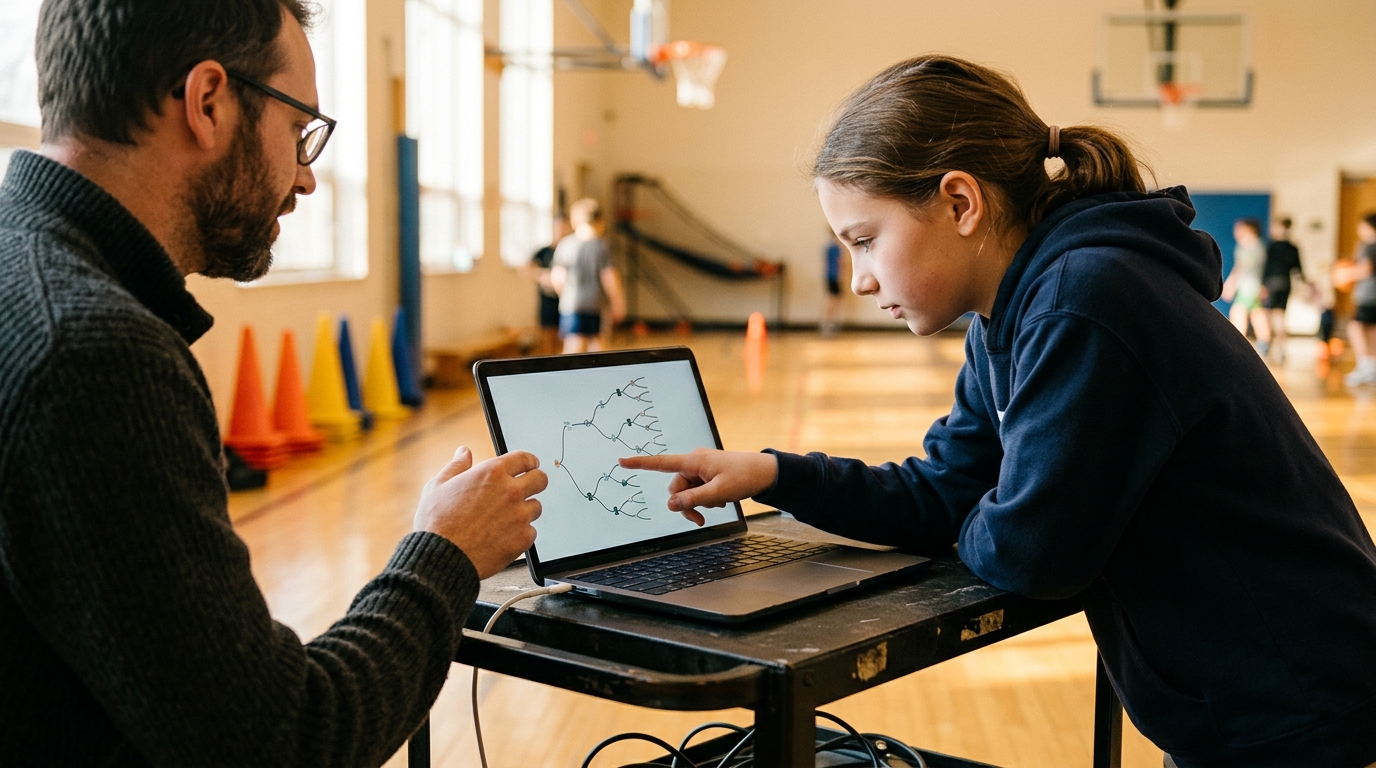

At 6:18 on a Tuesday morning, Elena Morales, a fictional seventh-grade science teacher, types a prompt into a text-to-game tool: create a 12-minute game about food webs in which students restore a damaged forest.
The result looks promising. There is a forest map, a choice at each turn, a score, three lives, and a countdown clock. Students earn points for choosing organisms that keep the ecosystem stable. Elena can picture the class leaning toward the screen instead of asking how much longer the lesson will last.
Then she plays it a third time. One feedback message says that decomposers return energy to the soil. Another branch treats a food web as a straight chain. Students can also win by selecting the middle option repeatedly, without explaining a single ecological relationship. The timer rewards quick guessing, while a careful reader spends time parsing the generated instructions.
By 7:45, Elena has a playable activity but no confidence that it measures what she intended. At lunch, a student tells her he won by memorizing the order of the choices. When the assistant principal asks whether the game can count as formative assessment, Elena pauses.
That pause captures the central problem with the rise of text-to-game platforms in K-12 EdTech. Generating a game has become easier. Deciding whether the game deserves classroom time remains a teacher’s job.
A playable output is not yet a lesson
Treat a text-to-game result as a draft, not as finished instruction.
What is a text-to-game tool? It converts a natural-language description of a lesson, audience, rules, and feedback into an interactive game or prototype. Many of these tools use generative AI, which can reduce the technical work required to make a first version. It cannot guarantee accurate content, accessible design, or useful evidence of learning.
The surprising bargain is that faster generation can create more checking work. When teachers build an activity by hand, they encounter each decision while authoring it: the answer key, the sequence, the scoring rule, the feedback, and the places where a student might get stuck. A generated game hides many of those decisions inside a polished output. The work has moved; it has not disappeared.
Plass, Homer, and Kinzer’s 2015 framework for game-based learning distinguishes game mechanics from learning mechanics. A rule may make an activity more playable without making the intended thinking more likely. Biggs and Tang’s idea of constructive alignment offers a useful test: the learning goal, student action, and evidence should point in the same direction.
Before writing a prompt, Elena creates a short learning contract:
Target: Students will predict how removing one species changes at least two other populations and justify the causal links.
Player action: Choose an intervention, predict consequences, and explain the chain.
Feedback: Identify which relationship caused the change, not merely whether the choice was correct.
Evidence after play: Explain a new ecosystem scenario without the game’s answer choices.
Her next prompt produces a less flashy activity. It has no leaderboard and no countdown. Each choice creates a delayed consequence, and the player must explain the change before moving on. It looks more like a small model of ecological reasoning than an entertainment product. That is an improvement.
Playtest for evidence, not applause
Before students see a generated game, play it with an inconvenient strategy. Click quickly. Ignore the feedback. Repeat the same choice. Try to win without reading. These tests reveal what the rules actually reward.
Evidence from digital game-based learning is broader than evidence about AI-generated games specifically. A systematic review and meta-analysis by Clark, Tanner-Smith, and Killingsworth, published in 2016, found that outcomes varied with design, comparison condition, and implementation. The label game-based learning did not do the instructional work by itself. Research on text-to-game generation is thinner still, so claims about automatic learning gains should be treated cautiously.
A useful playtest has three passes.
-
The rules pass. Look for guessing strategies, answer-pattern memorization, repeated clicking, and rewards for speed that have nothing to do with the objective. Check whether a student can lose because of dense reading, poor contrast, awkward keyboard controls, or a distracting animation.
-
The thinking pass. For every point, life, badge, or branch, ask what mental action it represents. Does a correct decision change the model, or does it merely move the player to the next question? Feedback should explain the reasoning behind an answer. Sweller’s cognitive load theory is relevant here: unnecessary rules and clutter consume working memory that students need for the subject itself.
-
The transfer pass. Give the learner a new problem after play. Remove the familiar answer choices and change one condition. If students can score well in the game but cannot explain the new case, the activity may be useful practice, but it is not evidence of mastery.
Retrieval practice can make a strong game loop when students must bring information to mind and use it. Karpicke and Roediger’s work on retrieval is a better foundation for a recall mechanic than a generic points system. A timer belongs only when speed is genuinely part of the learning target; otherwise it adds a second contest that may drown out understanding.
Elena asks her department’s science lead to play the forest game. The colleague wins the first round by spotting a repeated pattern. On the transfer question, however, she gives the same explanation as a student who had guessed. Elena changes the success condition: a player now has to state the relationship that supports the decision. The score becomes less impressive, but the evidence becomes more useful.
Put an adult checkpoint before generated content
Set a hard rule: anything generated for students remains a draft until an adult has checked every claim, answer, branch, and feedback message.
A quick read of the opening screen is not enough. Generated material can contain errors in the instructions, question bank, scoring logic, examples, image labels, and messages shown only after an incorrect choice. It can also turn a reasonable simplification into a false rule. A teacher needs to inspect the paths students may take, not only the path that appears in a demonstration.
For a short activity, create a simple source-and-change record. For each important statement, note the source checked, whether it is accurate, and whether it was kept, edited, or removed. A curriculum document, adopted textbook, primary source, or trusted disciplinary reference is a better check than asking the same generator to fact-check itself.
The review should include accessibility and age fit. Read the instructions aloud. Check keyboard access, color contrast, reading level, audio controls, and whether the interaction depends on reaction time or fine motor precision. Ask whether the game adds a barrier for multilingual learners or students using accommodations. Those are instructional questions, not cosmetic ones.
This fails when an educator treats fluent wording as evidence that the content is sound. Elena finds the most serious error in a feedback branch she had not opened. She now schedules the review before sharing the link, and keeps the source record with the lesson plan.
Keep student data and teacher authorship in the loop
A prompt can become a data record even when the final game shows no personal information.
Do not paste student names, identifiable work, behavior notes, disability information, IEP details, or family circumstances into an unapproved generation tool. Use fictional placeholders or aggregate descriptions instead. Before using a student-facing service, check what it stores, whether submitted material may be used to improve the service, who can access it, how deletion works, and whether its age and consent terms fit the school’s requirements. FERPA, COPPA, state laws, and local policies may all matter in the United States; a district privacy lead should resolve questions that a teacher cannot.
Students also deserve a plain explanation when their work or activity data is collected. “The system records your score” is more useful than a vague reference to personalization. If the tool is optional, provide an equivalent route to the learning goal.
Teacher control requires a record. Save the original prompt, the sources consulted, the generated version, the edits, the date, and the intended use. Keep an editable and exportable copy in a school-approved location rather than relying on a single account or link. Legal rights vary by contract and jurisdiction, but a sensible professional standard is clear: teachers should be able to inspect, revise, reuse, and remove the instructional artifact they created.
By Friday, Elena has a folder containing her learning contract, source notes, revised game, and transfer question. When another teacher asks to use the activity, Elena can explain its purpose and limits instead of forwarding an unexplained link. The game is no longer a mysterious object produced by a platform; it is a teacher-owned lesson draft with a visible chain of decisions.
Give the game one job
The best first use of a text-to-game tool is smaller than most demonstrations suggest. Choose one target, one meaningful decision, and one short play period. A game-based learning platform is most defensible when students must repeatedly make decisions, see consequences, receive useful feedback, and try again without real-world cost.
That makes text-to-game generation a reasonable fit for low-stakes practice, causal systems, vocabulary in context, source evaluation with clear criteria, or rehearsal of a process students have already encountered. It is a poor first choice for introducing a complex concept that needs teacher explanation, assessing nuanced writing, or handling sensitive historical and personal material where simplification can cause harm. It also should not replace a concrete experiment, discussion, or conversation simply because a game is easier to schedule.
Use this sequence during one planning period:
- Write the non-game evidence first: a response, explanation, prediction, diagram, or worked example that would show the target.
- Add constraints to the prompt: age, time, source material, accessibility needs, prohibited rewards, and the exact reasoning students must perform.
- Generate one small version, then run the rules, thinking, and transfer passes before assigning it.
- Pilot it with a colleague or a small, appropriate group and record where students guess, stall, or misunderstand the feedback.
- Keep it only if the post-play evidence is better than what students could produce without the game. Otherwise, revise the mechanic or retire the activity.
For Elena, the final prompt is narrow: create a 10-minute grade 7 ecology decision game in which each choice changes two populations, provide feedback about causal relationships, use no timer or leaderboard, and finish with a new scenario requiring a written explanation. Her students play it after direct instruction, then complete the transfer question on paper. She labels the game practice, not assessment, until she has stronger evidence.
That is a useful starting standard for the whole category. Before opening a text-to-game platform this week, write one sentence beginning, A student has learned this when… Then make the game earn its place by producing that evidence.