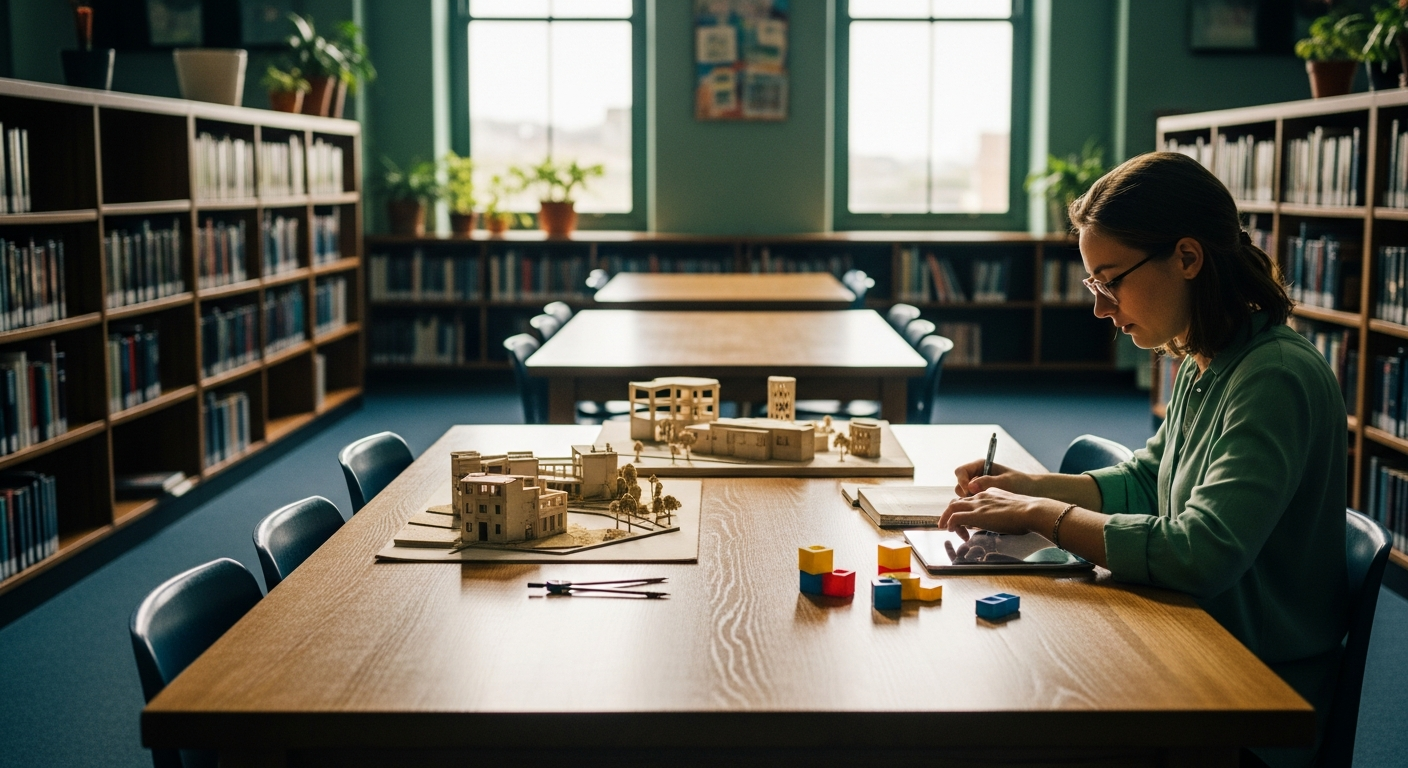

Elena stood in the doorway of her classroom at 7:30 AM, watching the morning light filter through the tall windows. It was 2030. Gone were the rows of desks tethered to a central whiteboard, replaced by flexible clusters that seemed to pulse with potential. Her desk was not a command center, but a hub of collaborative design. On her screen, a dashboard hummed with quiet activity, showing her that Maya, a quiet student who often struggled with complex abstract concepts in physics, had spent her morning interacting with a 3D simulation of fluid dynamics. Unlike the rote drills of a decade prior, the AI had guided Maya through a series of iterative experiments, adjusting the difficulty of the variables based on the logic she applied, not just the speed of her answers.
The Evolution of the Teacher-Student Dynamic
In the traditional models of the early 21st century, teachers often functioned as the primary, and sometimes sole, source of information. The transition into the future classroom requires a fundamental shift in this identity. Today, the role of the educator is transitioning from a lecturer to a curator of experiences. The future classroom relies on the AI copilot in education to handle the heavy lifting of assessment and content differentiation, freeing the teacher to handle the high-level cognitive work that machines cannot replicate: empathy, moral guidance, and the facilitation of complex group dialogue.
Moving Past Rote Memorization
For decades, education relied on the 'one-size-fits-all' lecture followed by the 'drill-and-kill' practice cycle. This model prioritized memorization speed over deep comprehension. By 2030, the emphasis has shifted toward mastery-based learning, supported by adaptive technology that understands the nuances of a student’s progress. When Maya struggles to grasp why a wing generates lift, the AI doesn't simply give her a quiz to memorize definitions. Instead, it adjusts the simulation, providing a scaffolded environment where she can manipulate air pressure and velocity in real-time, observing the physics in action. This approach aligns perfectly with Vygotsky’s Zone of Proximal Development, ensuring that learners are always challenged just enough to stretch their abilities without reaching the point of frustration.
Adaptive Learning as a Pedagogical Foundation
Back in her classroom, Elena reviewed the data for the upcoming week. The AI copilot had flagged that several students were hitting a plateau in their understanding of historical causality. Rather than assigning a generic worksheet, the system suggested a narrative-driven game for the class to explore. By placing students in the roles of historical figures navigating a complex political crisis, the AI allows them to test the impact of different decisions on the outcome of a fictionalized scenario. This is not gamification for the sake of entertainment; it is the use of structured simulations to build systems-thinking skills.
What does adaptive learning actually look like in the classroom?
Adaptive learning is a pedagogical approach that uses data-driven algorithms to tailor educational content to the individual needs of a student. In a 2030 classroom, this means that while one student engages with a complex, story-driven exploration of ancient trade routes, another student might be using a 3D model to visualize the molecular architecture of early human tools. The AI adjusts the difficulty, the modality of the content, and the pacing based on real-time feedback, ensuring that every student remains in the 'sweet spot' of learning engagement.
The Architecture of the Future Classroom
If the future classroom is defined by personalized, adaptive content, what happens to the physical and conceptual environment? The room itself must be as fluid as the curriculum. We have moved away from the industrial factory model of schools toward a design that supports diverse modes of work—individual research, small-group collaboration, and teacher-led seminars. The technology is present, but it is invisible, woven into the fabric of the learning process rather than standing as a barrier between the student and the teacher.
Elena walked over to Maya, who was now sketching out a diagram on a physical whiteboard, synthesizing what she had learned in the simulation. The AI had provided the challenge, but the synthesis—the true act of learning—was happening between human minds. This is the core of the modern educational standard: AI handles the personalized pathways and immediate, actionable feedback, while teachers facilitate the deep, collaborative work of sense-making. In this setting, the teacher is not replaced by an AI copilot; they are amplified by it.
How will AI change the role of the classroom teacher?
AI will function as a powerful assistant that takes over the administrative and repetitive tasks of grading, scheduling, and content adaptation. This allows teachers to dedicate their time to high-impact activities such as mentorship, emotional support, and the design of complex, cross-curricular projects. The teacher remains the architect of the learning experience, with the AI serving as the builder who handles the individual student's construction needs.
Embracing the Complexity of Learning
There is a common misconception that technology simplifies the classroom. On the contrary, true educational innovation makes the classroom more complex and more human. By offloading the logistical burden of differentiation, educators can finally lean into the messy, unpredictable nature of genuine inquiry.
When we look at the trajectory toward 2030, we see that the most effective classrooms are those that reject the dopamine-fueled loops of older gamified apps. Instead, they embrace systems that reward curiosity and sustained effort. When a student chooses to spend an extra ten minutes exploring a 3D model because they want to understand a phenomenon, that is a success. When they collaborate with a peer to solve a problem that the AI presented, that is mastery.
As Elena ended her day, she didn't feel the usual exhaustion of a teacher who had spent seven hours repeating the same lecture. She felt the satisfaction of a conductor who had guided a symphony of independent learners. The data on her screen was not just a list of scores; it was a map of potential, showing exactly where each student was growing and where they would need her human intervention tomorrow morning.
Preparing for the Next Decade
For educators and administrators reading this, the transition toward the 2030 classroom does not happen overnight. It begins with a shift in mindset. Start by identifying the most repetitive, time-consuming parts of your current curriculum—the parts that feel like they are just checking a box. Look for ways to introduce adaptive tools that allow students to explore those same topics through simulation or inquiry.
This week, evaluate your current lesson plans through the lens of Bloom’s Taxonomy. Are you asking students to simply remember and understand, or are you creating opportunities for them to analyze, evaluate, and create? If you find you are stuck in the lower levels of the taxonomy, use that as your entry point for testing new, AI-supported activities. The classroom of the future is not a destination we arrive at; it is a way of working that we begin to build today, one interactive, human-centered lesson at a time.