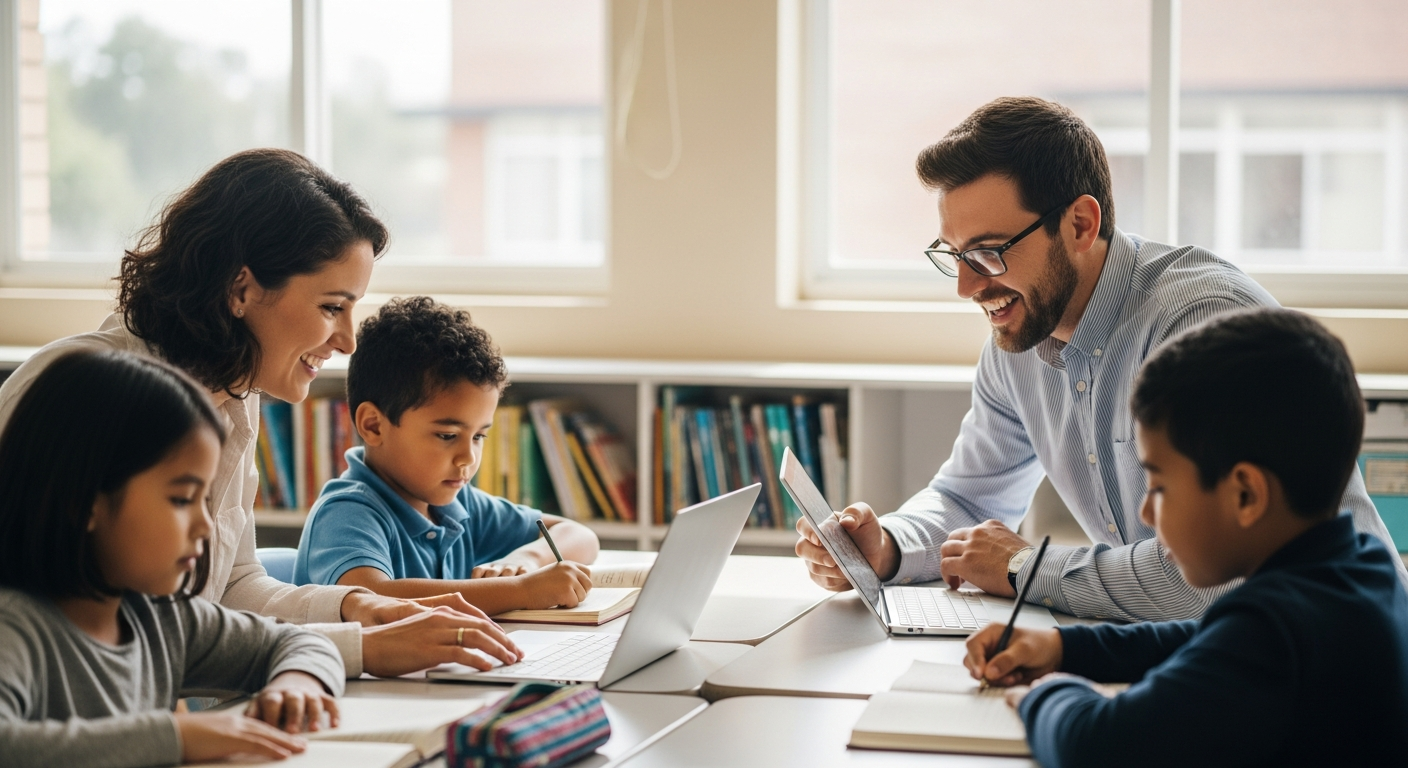

Reimagining the Learning Environment: Beyond the Industrial Model
For decades, the educational model has remained largely static: one teacher, thirty students, and a standardized curriculum delivered at a single, inflexible pace. By 2030, this industrial-age relic will be replaced by a highly personalized ecosystem. The shift is not about replacing the educator with software; it is about providing an AI copilot in education that manages the granular logistics of differentiation, allowing teachers to focus on the human elements of mentorship and complex facilitation.
What is an AI Copilot in Education?
An AI copilot in education is a sophisticated digital assistant that works alongside a teacher to generate instructional materials, assess student progress in real-time, and adapt learning paths based on individual needs. Unlike automated chatbots that merely provide answers, an effective copilot acts as a pedagogical partner that synthesizes complex data into actionable classroom strategies.
The Architecture of the 2030 Classroom
The future classroom relies on adaptive learning—a method where the educational content evolves in complexity and format based on the student's actual performance, rather than an arbitrary timeline. This aligns perfectly with Vygotsky’s Zone of Proximal Development (ZPD). When students are consistently challenged just beyond their current ability but within reach of success, engagement levels shift from passive consumption to active mastery.
Mastery-Based Mechanics vs. Speed-Based Gamification
We are currently witnessing a pushback against the 'gamification' of the past decade, which often relied on extrinsic motivators like leaderboards, streaks, and loot-box-style rewards. These mechanics often induce anxiety and prioritize speed over depth. The next generation of learning tools focuses on:
- Mastery-Based Progression: Students unlock new concepts only when they have demonstrated deep understanding, not when they have performed a repetitive task fastest.
- Retrieval Practice: AI systems intelligently reintroduce old concepts at optimal intervals, strengthening long-term memory retention.
- Meaningful Interaction: Simulations that challenge students to apply concepts in real-world scenarios rather than rote memorization tests.
Human-in-the-Loop: The Teacher as Architect
One of the most persistent fears regarding AI in schools is the loss of teacher agency. However, the most effective future-state models utilize a human-in-the-loop framework. In this system, AI generates the draft of a lesson, a simulation, or an assessment, but the teacher serves as the final validator. This ensures that the nuance of cultural context, social-emotional awareness, and pedagogical intent remains firmly under professional control.
How Teachers Can Leverage AI Today
- Concept Synthesis: Provide a prompt about a complex topic (e.g., 'the physics of bridge building') and have the AI generate a tiered simulation that caters to different levels of scientific literacy.
- Curriculum Mapping: Use AI to cross-reference learning standards with classroom activities to ensure no key concept is missed.
- Feedback Loops: Use AI to analyze formative assessment data to identify which students are struggling with specific sub-skills, allowing the teacher to conduct high-impact, small-group interventions.
Privacy and the Ethics of Data
As classrooms become more digitally integrated, data privacy becomes the primary concern for school administrators and parents. The transition toward zero-knowledge privacy is essential for the future classroom. By implementing systems where PII (Personally Identifiable Information) is never stored—using methods like emoji-based authentication—we can protect student identities while still allowing the system to track individual learning progress.
Comparison: Traditional vs. Future Classroom
| Feature | Traditional Classroom | Future Classroom (2030) |
|---|---|---|
| Pacing | Fixed, teacher-led | Adaptive, learner-led |
| Feedback | Delayed (Grading) | Instant (Formative AI) |
| Motivation | Extrinsic (Grades/Points) | Intrinsic (Mastery) |
| Privacy | High risk (PII storage) | Zero-Knowledge (Emoji IDs) |
Fostering a Fair Creator Economy
As we look toward 2030, the role of the teacher is evolving from a content consumer to a content creator. When teachers create brilliant, adaptive simulations that help their students master difficult concepts, those tools should have value. A sustainable educational ecosystem must support a fair creator economy, ensuring that educators who build high-quality, effective learning modules are compensated when those tools are shared or utilized across a wider educational network. This incentivizes the creation of high-quality, pedagogical-first resources over disposable digital busywork.
Actionable Steps for the Transition
If you are an administrator or a lead teacher, you do not need to wait for 2030 to start implementing these principles. Begin by evaluating your current digital tools against three criteria:
- Does this tool replace teacher judgment, or support it? Choose tools that allow for human-in-the-loop validation.
- Does it prioritize mastery, or just speed? If a platform relies on timer-based rewards, consider moving toward tools that incentivize deep reflection and conceptual application.
- Is student data treated as a liability or an asset? Prioritize platforms that minimize data collection and emphasize privacy by design.
Moving Forward
The future classroom is not a sterile environment filled with robots; it is a vibrant space where technology handles the heavy lifting of differentiation and data analysis, leaving teachers free to do what they do best: inspire, facilitate, and connect. By embracing adaptive learning and insisting on privacy and mastery-based outcomes, we can build a school system that serves every child regardless of their starting point. The transition requires a shift in mindset—from viewing AI as an external disruption to treating it as an internal copilot that honors the complex, human craft of teaching.