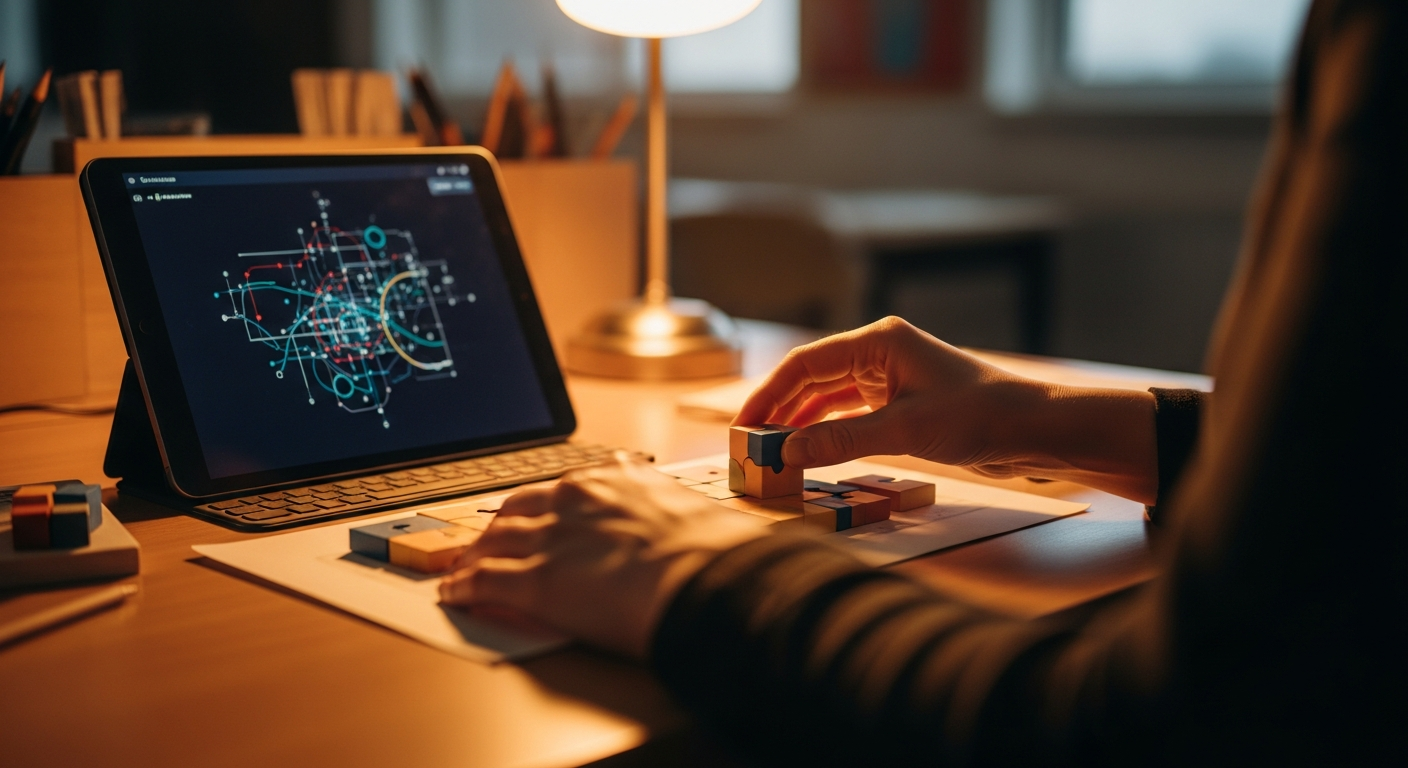

Beyond the Digital Textbook: Envisioning the Future Classroom
For decades, the educational model has remained largely static: a teacher stands at the front, delivering a standardized curriculum to thirty students with thirty different learning needs. While tools like Kahoot or Quizlet introduced basic gamification to increase engagement, they often rely on surface-level recall and speed-based competition. As we look toward the classroom of 2030, we see a fundamental shift. The future classroom is defined not by the hardware on student desks, but by the intelligence of the systems surrounding them. By leveraging an AI copilot for education, teachers are evolving from lecturers into architects of sophisticated, adaptive learning environments.
What is an AI Copilot in Education?
An AI copilot in education is a collaborative system that assists educators in creating, managing, and personalizing instruction. Unlike a simple search engine or automated grading tool, a true copilot helps the teacher design complex, project-based simulations or mastery-based assessments that align with individual student progress. It acts as an extension of the teacher's pedagogical expertise, allowing them to scale their impact without sacrificing the human element.
The Shift to Mastery-Based Gamification
Many current EdTech solutions prioritize dopamine loops—frequent, shallow rewards that keep students clicking but do little to deepen understanding. This is the 'gamification of the surface.' True mastery-based gamification, however, treats the classroom like an immersive simulation. In this model, students progress not by how fast they finish a quiz, but by how well they demonstrate competency in a given domain.
Traditional Gamification vs. Mastery-Based Simulation
| Feature | Traditional Gamification (e.g., Kahoot/Quizlet) | Mastery-Based Simulation |
|---|---|---|
| Focus | Speed and Recall | Depth and Application |
| Motivation | Extrinsic (Leaderboards/Points) | Intrinsic (Skill Acquisition) |
| Feedback Loop | Immediate binary (Correct/Incorrect) | Iterative/Process-oriented |
| Pedagogical Goal | Memorization | Demonstrated Understanding |
By moving away from 'beat-the-clock' mechanics, educators can prevent the anxiety often associated with digital learning. When a student knows their progress is based on genuine skill development, they are more likely to embrace the 'Zone of Proximal Development'—the sweet spot where a task is challenging enough to require effort but achievable enough to remain engaging.
Protecting Student Agency and Privacy
As we integrate more technology, the conversation around data security becomes paramount. The future classroom must be built on the principle of 'Zero-Knowledge' privacy. Students should be able to access sophisticated, adaptive learning tools without the need for PII (Personally Identifiable Information) collection. Using methods like emoji-based authentication or anonymous lockers ensures that the classroom remains a safe space for intellectual risk-taking.
Teachers, likewise, deserve to own the content they create. When an AI copilot assists in drafting a complex tycoon-style game or a simulation, the educator remains the owner and curator of that work. This 'human-in-the-loop' approach is non-negotiable; AI should never be the final judge of student progress. The teacher validates the AI-generated material, ensuring it meets the unique cultural and academic needs of their specific student population.
How to Implement Adaptive Learning Today
Transitioning to a future-ready classroom doesn't happen overnight. It starts with a shift in mindset—from 'covering the curriculum' to 'fostering mastery.' Follow these steps to begin your transition:
- Identify the Bottlenecks: Look for concepts that students consistently struggle with. These are the perfect candidates for a simulation-based activity.
- Curate, Don't Just Collect: Instead of relying on pre-packaged content found on sites like TPT, use AI to create original scenarios that relate directly to your students' lives.
- Prioritize Process Over Speed: Remove the timers from your assessments. Allow students to iterate on their work until they reach proficiency.
- Validate AI Content: Always review AI-suggested activities for accuracy and tone. Ensure the 'human-in-the-loop' is the final gatekeeper for all educational materials.
Preparing for 2030: The Role of the Teacher as Creator
In the coming years, the teacher's role will shift from 'content delivery agent' to 'learning designer.' The most effective classrooms of 2030 will be those where the teacher uses AI to build complex, project-based environments that feel more like discovery labs than sterile testing centers.
By focusing on authentic learning over rote drill, educators can cultivate critical thinking skills that are impossible to measure through traditional multiple-choice exams. We must reject the notion that EdTech is a replacement for human connection. Rather, it is a tool that clears the administrative clutter, giving teachers the time and space to mentor students individually. The future is not about replacing the teacher with a machine; it is about empowering the teacher with a machine that amplifies their unique ability to inspire.