Start Here
A few of our favourite activities, across grades and subjects
Some of the best activities on Argraide. Play any of them the way a student would, check how they're graded, then remix one for your own class by typing what you'd change.
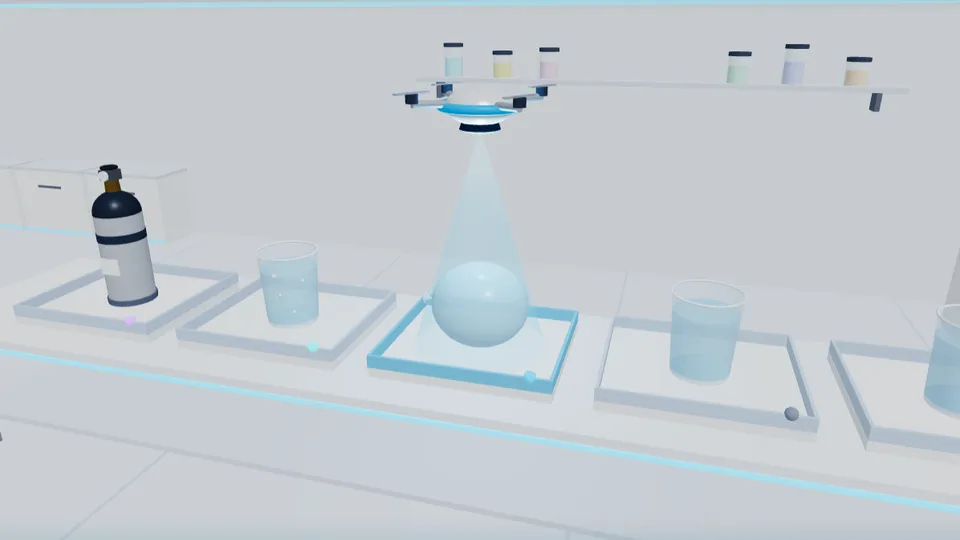
A clean white nanotech lab in soft blue light. A hovering lens drone dives from everyday samples on their trays (a balloon of air, a spoon of table salt, a gold ring, tap water) down to their particles, then into one particle. Students predict from the outside look, dive in, and sort each sample by what the particles show: pure substance or mixture, then element or compound.
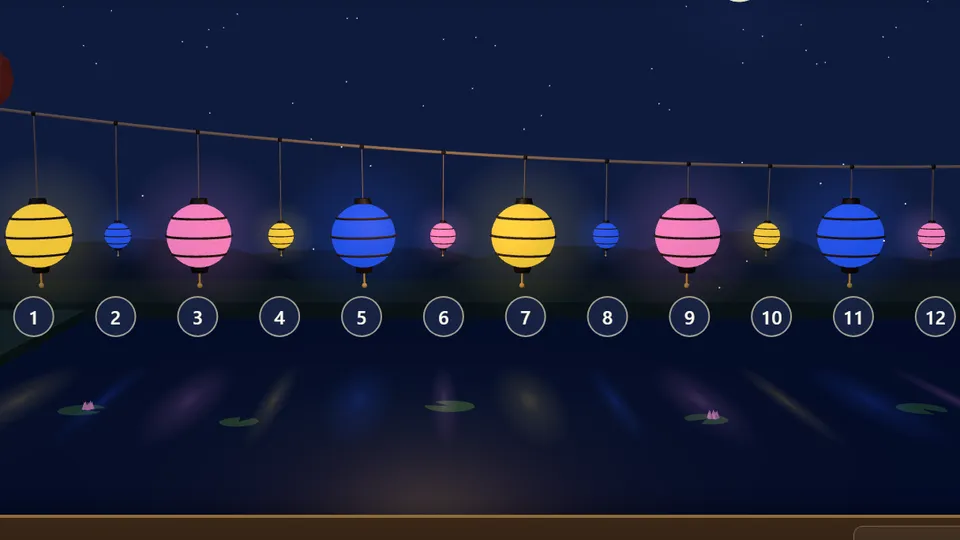
Au projecteur, la classe lit des guirlandes de lanternes en 3D au-dessus d'un étang : quels attributs changent, où est le motif, quel est le terme suivant, le 15e, le terme manquant, la lanterne brisée, puis le même motif dans un autre attribut. Chaque réponse est fabriquée à l'établi (couleur, forme, taille).
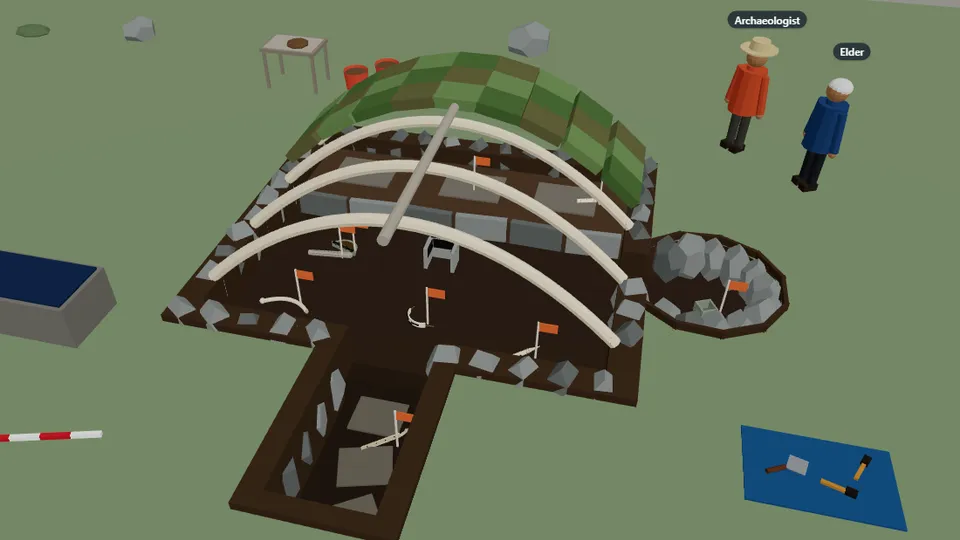
A 3D archaeology dig of an early Inuit winter house on an Arctic coast. Students dig a grid layer by layer, turn each object to read the clue drawn on it, sort the evidence into trays, read the house's parts, then judge claims about early Inuit life with one and then two pieces of evidence.
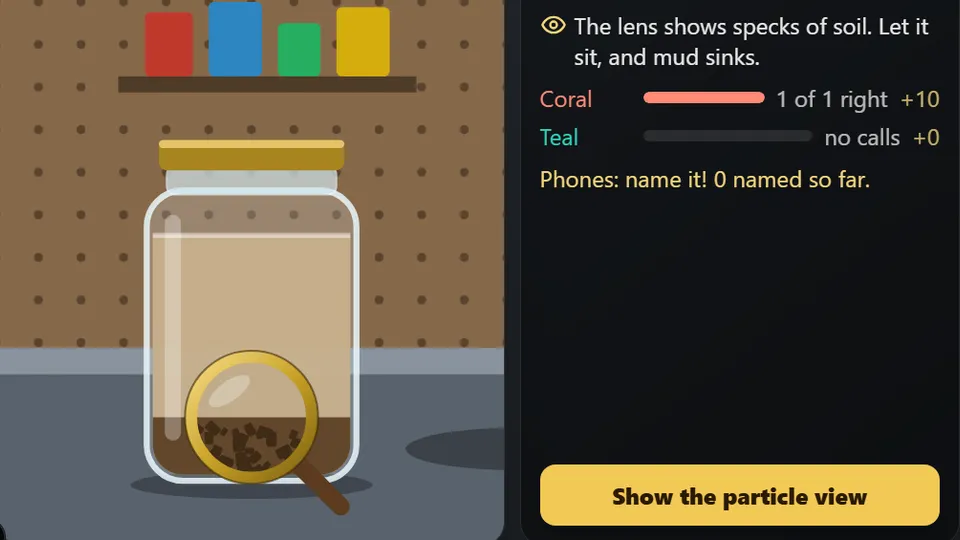
Two teams test 13 mystery mixtures from the kitchen, the garage and the lab with a brass lens on their phones, call each one homogeneous or heterogeneous from the evidence, then name it as a solution or a mechanical mixture with the particle view.
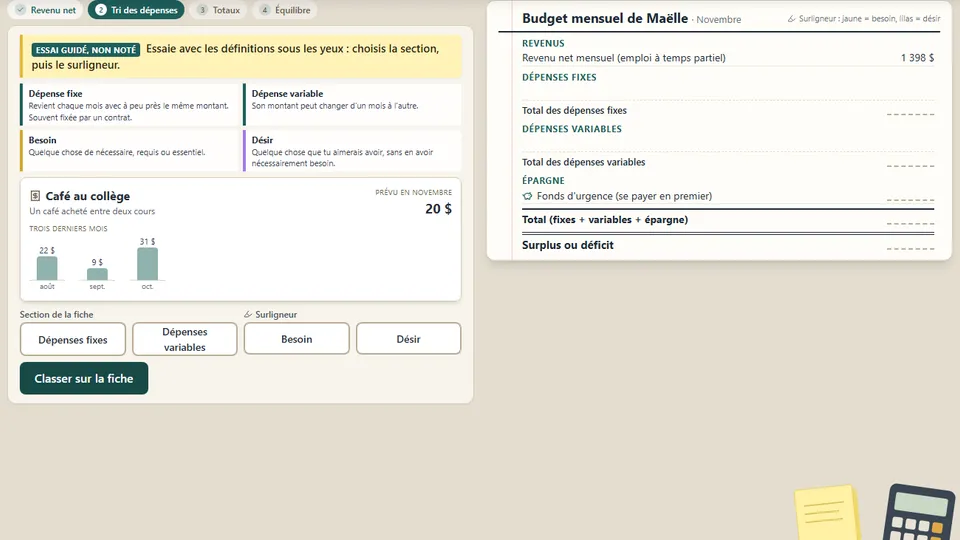
Budget : la répétition générale

Une répétition générale du travail de budget : l'élève remplit, ligne par ligne, la fiche de budget mensuel d'une étudiante fictive de 18 ans (Revenus, Dépenses fixes, Dépenses variables, Épargne, Total, Surplus ou déficit). Revenu net à partir d'un talon de paie, tri des factures, épargne d'abord, totaux, puis un plan pour équilibrer un mois déficitaire sans couper un besoin, sauter l'épargne, briser le bail ni emprunter.
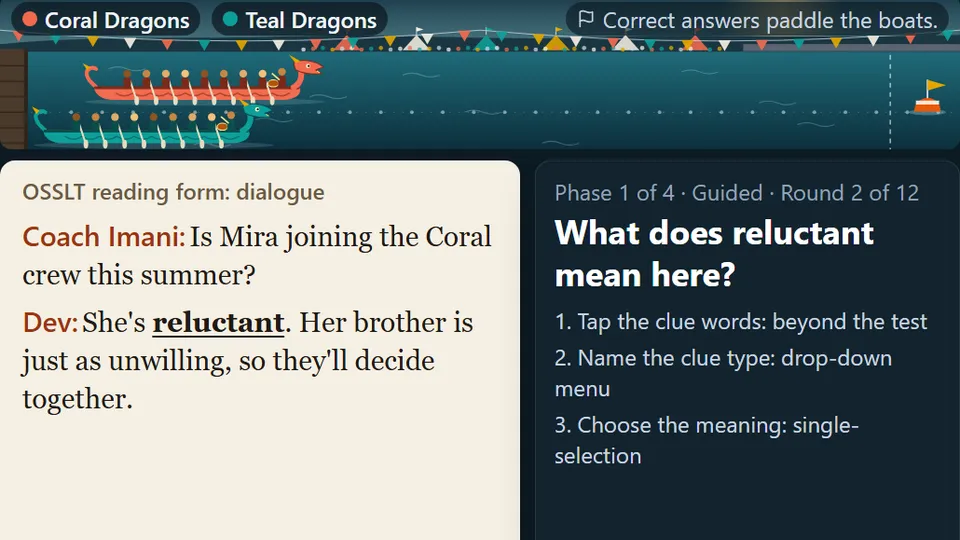
Two dragon-boat teams race across the big screen at a fictional Lake Ontario harbourfront festival. Each round shows one or two short original sentences in one of the OSSLT's four reading forms with one unfamiliar word; every phone taps the clue words, names the clue type in a drop-down menu and chooses the meaning in single-selection, and correct answers paddle that phone's team toward the finish buoy.