Back to The Library
Freeze-Thaw Lens: Particles in a Prairie Year
Created by Argraide
Updated October 16th, 2026
At a glance
- Play mode
- 📱 Solo
- Format
- 🧊 3D
- Length
- ⏱ About 20 minutes
- Subject
- Science
- Grade
- 6
- Curriculum
- Alberta
- Curriculum code
- 6M1
About this activity
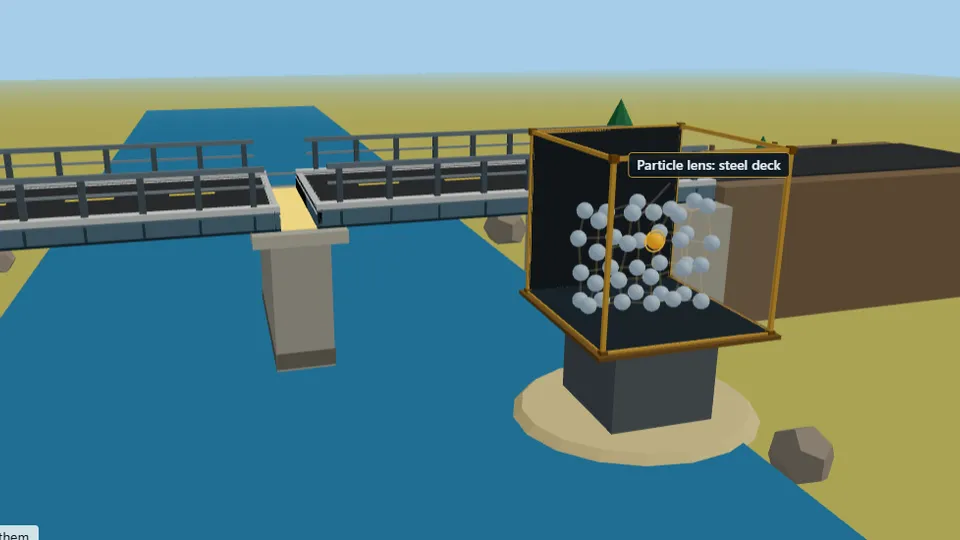
A 3D prairie year from a -35 °C cold snap to a +30 °C afternoon. Students predict what a bridge deck, a thermometer, a lake, a sidewalk and a balloon do at full size, then build the particle picture that explains it.
What students learn
- Explain with the particle model that heating makes particles move faster, weakens the attractive forces between them and increases the space between them, and cooling does the opposite
- Predict expansion and contraction of solids, liquids and gases, and how a liquid thermometer works
- Relate 0 °C and 100 °C to the melting/freezing and boiling points of water on the Celsius scale
- Explain water's unusual property: solid water has greater volume and is less dense, so lakes freeze at the surface and the ice sheet protects aquatic life
- Show that the mass of a substance stays the same through a phase change while its volume may change
- Explain why sidewalks, bridges and roads are built with room for expansion and contraction
Reviews
No reviews yet. Be the first to review this activity!
Sign in to review